Space, the first frontier… in your home
Ok, so first things first. We need to help you set up space in your house. There are so many ways we will work on modifying rooms in your home, and the most accessible place to start is the kitchen.
Because you are in your house, instead of creating a space that is devoted to the area of Montessori education called Practical Life (the part of the studio where children pour, scrub, etc.), you have a kitchen!
A comfortable place to start is the fridge.
At school, children are free to snack when they are hungry. This freedom works for a few reasons.
The first reason it works is that, for the most part, children drink water and eat whole grains, fresh fruits, and veggies. Because every choice is healthy, we don’t worry about what they are eating.
Second, everything is accessible. In the studio, children have access to a small kitchen like area. In your kitchen, you can devote a shelf in the fridge and a bottom cupboard so that children can serve themselves when they are hungry.
In the fridge:
Take a low shelf in your fridge.
Clear it of everything except:
- a small pitcher of water (could be a creamer pitcher, or child-sized pitcher
- a few containers of fruits, veggies, or both.
Fruits: clementines are perfect. Clementines are easily peeled by children, which is a great skill to practice. Children get valuable work for their hands and finger strength, and it takes them a little time to do it, so they are developing their concentration, and it provides a sense of independence. Clementines offer the trifecta of Montessori principles! Bananas are also perfect. For younger children, you can cut them in half. You can show children how to pull them apart, lengthwise into three pieces, or slice them.
Veggies: Carrots, in any form, are excellent. Typical carrots can be scrubbed, sliced, diced. Radishes are also stellar! Radishes are easy to grow, and this time of year in North America is perfect. Radishes can be scrubbed, sliced, and make an ideal treat after baking them in a toaster oven.
In the Cupboard
Take the bottom cabinet closest to the fridge and find a new home for what’s inside.
Then add a few containers of crackers, some small snack or salad plates, small glass juice sized glasses, a little holder with a few forks, spoons, a spreader, and a serrated butter knife.
Remember, though that when children first encounter freedom they’ve not experienced, they practice it a lot! When you set up a little pitcher of water, your child will drink more water than they ever have! Not because they are thirsty, but because *they can*!
No worries! Things will settle down as they come to say the freedom isn’t going away. The same is true for serving themselves snacks.
For this reason, I’ve suggested something like raw carrot chips or baby carrots that the first week. Carrot chips are easy to serve, and best of all, they are inexpensive. Only have big carrots on hand? No problem. Just cut them into slices. Better yet, show your child how to cut them into slices before eating them!
At school, all eating happens in the practical living area. We do not take food to other areas of the room.
The kitchen is suited to food prep and eating. If you have a dining room, you might have children sit at the table after prepping the food. Then back to the kitchen for clean-up and washing the dishes or, at the very least, loading the dishwasher.
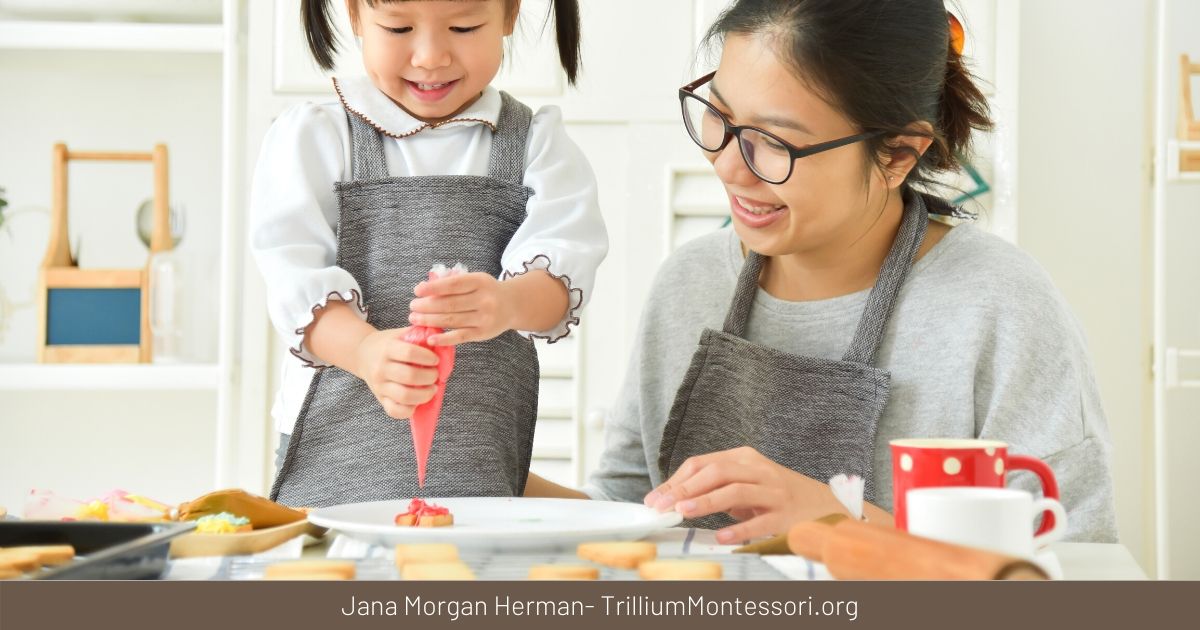
Even young children can help prep food or prep food on their own.
My children were helping in whatever capacity matched their ages. An 18-month-old can wash dishes, scrub fruits and veggies, add and stir ingredients, even, gasp, help cook! If that last point makes you uncomfortable, you can baby steps to it over some time.
Remember that you’ll need to adjust your mindset to prioritize the process for children and not the product. Not much will be Pinterest pretty. That’s ok.
If we want children to try things out, we have to encourage (without unnecessary praise) and then resist the desire to correct.
Remember, things will break, food will have a less than perfect appearance. If you are trying out a new skill with someone you adore, you may be reluctant to continue trying if they correct everything you do. Montessori said for us to develop a friendly relationship with error!
Relax and enjoy the process.
Whatever you do in the kitchen, pause and reflect on how you can slow down.
Often children struggle because the adult moves too fast for the child to see what the adult is doing. Then when it is their turn, they approximate what they saw.
Also, try not to talk a lot while your hands are moving.
Children are used to listening to us, so if we are talking a lot, the child shifts their attention from what the hand is doing to your face and, in the process, misses essential movements.
If something is tricky, you can always go back and add more verbal detail later.
In the studio, my goal when I’m introducing something into practical life is to ask myself: is there a way to set this up so the child can do this without me?
Abilities will vary by age and will change over time. In our studios, we have 2.5-year-old children and children who are 6- that’s a huge range! Yet, by refection and modification based on observation, we manage to meet the needs of all children, and you can, too.

Jana Morgan Herman
I’m Jana Morgan Herman. I have been in Montessori for almost 30 years, as a parent, teacher, and teacher trainer. My own children started in Montessori at 18 months and attended Montessori through high school. I was a classroom teacher for most of that time and for the last 5 years have been a school director. I hold 2.5-6 credential from American Montessori Society (AMS), RIE 1 from RuthAnne Hammond and Deborah Greenwald, and a Masters in Montessori education. I homeschooled my children for several years and integrated Montessori principles during that time before working in both private and public Montessori schools.