Over the years, I’ve collected a lot of classroom materials. I mean, a lot. If you’re a teacher, there’s a good chance you know exactly what I’m talking about. It starts with a few cute trays, a stack of themed printables, some thrift store finds that might come in handy one day… and before you know it, you’re knee-deep in bins and baskets labeled with words like “Spring,” “Insects,” and “Misc (but Good).”
And here’s the thing—I like organizing. My materials are all carefully sorted, labeled, and put away. Nothing’s spilling out of cabinets. It’s not chaos. So for the longest time, I thought I was pretty on top of things.
I considered myself an unclutterer, until I realized I was a fake unclutterer. Here’s a quote from the Unclutterer blog that shows what I mean:
“My mom was the perfect example of a fake unclutterer. She had every closet crammed with stuff, all categorized and neatly organized in plastic boxes. It didn’t look bad until you pulled it all out and realized just how much junk she saved. Yes, junk–hundreds of neat little bundles of twist ties for one example. All useful junk in reasonable quantities, but several lifetime supplies of pens, pencils, sewing needles, thread, chopsticks, notepads, letter openers, grocery bags, paper coasters, tape, hotel soaps and shampoos, ad infinitum.”

I wasn’t disorganized—I was just organized in three dimensions. What I needed was the fourth dimension: time.
It wasn’t until I started thinking about when I was actually going to use all the materials I’d collected that I began to feel truly organized. I’m still working on it—but that small shift made a big difference.
In this article, I’ll walk you through how I began organizing my classroom materials in four dimensions and how that led to a more thoughtful and manageable planning process. If you’re also sitting on a mountain of beautifully labeled bins, you’re not alone. Let’s make them work for us.
What Does It Mean to Organize in Four Dimensions?
Most of us are pretty good at organizing in three dimensions. We sort, label, stack, store, and contain. We use bins, folders, drawers, and color coding. We know where things are (most of the time). That’s three-dimensional organization—managing what we have and where it lives.
But there’s one big question three-dimensional organizing doesn’t answer:
When are you actually going to use it?
That’s where the fourth dimension—time—comes in.
Organizing in four dimensions means thinking not only about what you have, but also when you’ll need it, how often you’ll use it, and why you’re keeping it at all. It’s planning with intention.
Without time in the equation, even the most beautifully sorted materials can become invisible. They sit quietly in the back of the closet, year after year, waiting for “someday.” And as we all know, “someday” rarely shows up on the calendar.
When I started asking myself, “When exactly will I put this out?”, everything changed. I began thinking less about how to store things and more about how to use them—what month, what unit, what season. It helped me stop collecting just for the sake of it and start creating a clear plan for what would actually end up on my shelves.
So yes, organizing in four dimensions is really just another way of saying planning—but I like thinking of it as giving my materials a place in time, not just in space.
A Note for Montessori Educators
Before we dive deeper, I want to pause and share something important—especially if you’re new to Montessori or just getting started with planning.
In Montessori education, the foundation of our work is observing and following the child. That’s where the heart of our classroom planning lives. Everything else—the seasonal units, themed shelf work, holiday activities—these are extras. They’re the gravy, not the main course.
For the first ten years of my teaching practice, I focused almost entirely on the core of Montessori: the prepared environment, the three-period lesson, the scope and sequence of the Montessori materials, and learning how to truly follow each child’s interests and development. That was more than enough.
The kind of planning I’ll share in the rest of this article is what I started adding later, once I had a solid grasp of the fundamentals. It’s the kind of planning that helps keep the classroom fresh and engaging—for the children and for me. But if you’re still building your foundation, don’t feel pressure to add themed units or shelf extras right away. Start with the basics, and layer in the rest when you’re ready.
And when you do feel ready, planning your extras with the fourth dimension in mind can be a gentle and joyful way to bring new life to your classroom—without the overwhelm.
Three Approaches to Cultural Curriculum Planning
When it comes to planning the Montessori Cultural (or Cosmic) Curriculum, there’s no one right way to do it. Over the years, I’ve experimented with a few different approaches, and I’ve seen many teachers do it in ways that fit their classroom size, student needs, and personal style.
Here are three common approaches I’ve tried or considered:
1. All-Year Cultural Shelf
Some teachers like to put all their cultural materials—zoology, botany, geography, etc.—on the shelves all year long. This gives children the freedom to explore topics when they’re interested. It sounds wonderful in theory, and I really wanted to make it work as a new teacher.
But… I quickly learned two things:
- I didn’t have enough shelf space.
- Too many options at once can be overstimulating for some children.
If you can pull this off in a calm and orderly way, great! But it wasn’t a good fit for me or my space.
2. Rotating Cultural Shelves
For a while, I had a dedicated shelf for each subject—one for geography, one for zoology, one for botany—and I rotated the materials regularly. Each day, I introduced one new item or lesson on one of these shelves.
This approach gave me structure and variety without overwhelming the environment. It worked well for a number of years, and it’s a solid option if you like to keep things fresh and offer a range of topics without shifting the whole classroom theme.
3. Unit Studies (My Preferred Approach)
I finally settled on using a unit studies approach. I choose a theme—like insects, the ocean, or North America—and build several shelf activities around that topic. I leave them out for a few weeks or a whole month and weave the theme into circle time, books, art, and even snack or outdoor activities when possible.
I’ve found I really enjoy the repetition of exploring one topic for a while. It’s calmer for me and for the children. I found that I did not enjoy doing a new topic every day. If we’re talking about bugs, I want to talk about bugs consistently for a few days and not do bugs one day, Africa the next day, and flowers the day after that.
This unit study approach is what I’ll focus on in the next section—how to plan your year in a way that brings purpose and timing to all those wonderful materials you’ve collected.
Free Webinar
If you find managing your curriculum planning overwhelming, this webinar will give you a simple process to keep things organized while keeping your focus on the developmental needs of your students.
Step-by-Step Planning Process
So how do you bring that fourth dimension—time—into your organizing and planning? Here’s the process I’ve been using to make sure my materials don’t just sit in a closet waiting for “someday.”
Step 1: Take Inventory
Before I can plan anything, I need to know what I already have. This doesn’t mean I pull everything out of the closet and make a giant mess (learned that lesson the hard way). Instead:
- I take a quick scan of what’s already neatly stored.
- If things are scattered in different places, I snap photos of each bin or shelf. That way I don’t forget what’s tucked away.
This step helps me avoid reprinting, rebuying, or reinventing the wheel.
Step 2: Brainstorm Possible Units
Once I know what I’ve got, I make a list of themes or units I could build around those materials. If I already have enough for a full unit—great! That topic goes straight onto my planning list.
If I only have a few pieces, I might save the idea for the future or plan to slowly build it out with new resources.
Step 3: Build a Year-at-a-Glance Grid
This is where the fourth dimension really kicks in. I start plotting out the year with a simple monthly grid. Here’s how:
- First, I fill in any obvious seasonal themes (pumpkins in October, life cycles in spring, etc.).
- Then I think about the big picture: what kind of flow do I want for the year? In Montessori, we go from simple to complex and concrete to abstract. The cosmic curriculum goes from big picture to details.
This becomes my roadmap for the year. It’s flexible, but it helps guide my planning (and gives me a place to plug in all that “someday” stuff). Here’s a snapshot of the year-at-a-glance grid I used for many years:

I use grids a lot. They give me a ton of information at once 🙂
Once I have an overarching sequence, I will break that down by month and add it to the months column. One year, for example, the sequence looked like this:
- August: Health & Safety
- September: Intro to My World
- October: Plants and Harvest
- November: North America
- December: Holiday Traditions
- January: The Earth and Space
- February & March: Around the World
- April: Ecology/Environment
- May/June: Animals
Now I can fill in the smaller units within the monthly themes, like this (click to see larger image):

Step 4: Detail Each Unit
Now that I have my outline for the year, I can start to flesh out the details.
Again, there are many ways to do this. You can use a standard plan book from a teacher supply store or make your own.
A simple way is to just take a sheet of paper for each unit and make columns for each of the different areas of the classroom. Be sure to include things like Music, Snack, Outdoors etc. Within these columns, start plugging in the materials you already own. Next, add ideas you’d like to try but which will involve more research and resources.
Sticky notes work well for this if you’re working on paper. If you’re digital, Google Docs, Sheets, Evernote, Trello, or Notion all make great planning tools.
Having it laid out like this puts me in a better position to decide whether it’s worth it to purchase more stuff for my hoard collection or not.
Step 5: Track and Reuse
As I go through the year, I try to take photos of each shelf layout and jot down quick notes on what worked (and what didn’t). This helps me:
- Repeat favorite units with minimal effort
- Avoid mistakes I’ve already learned from
- Build a reference library of classroom setups over time
Each year gets easier when I have a record of what I’ve done.
Tools I Use For Curriculum Planning
There’s no one right way to plan, and your system doesn’t need to be fancy to be effective. Whether you prefer writing things by hand or using digital tools, the goal is the same: make it easy to find and use your ideas when you need them.
Here are a few tools that have helped me stay organized over the years—and some that I’ve found work better now than what I used in the past.
Pinterest is still one of my favorite tools for collecting and organizing inspiration. I use it to:
- Save ideas I come across in blogs or on social media
- Sort visuals into themed boards (by unit, season, subject, etc.)
- Quickly find activities when I’m planning a unit
Just be sure to keep your boards labeled and organized so they’re easy to navigate when planning time rolls around.
Google Drive or Dropbox
Google Drive and Dropbox are great for keeping everything in one place.
- Make a folder for each theme and month
- Add any printables you’ve collected
- Use Google Sheets or your preferred spreadsheet for your year at a glance plan and a theme index
Trello or Notion
If you enjoy visual or checklist-based planning, any of these three tools can be a great option:
- Trello is a drag-and-drop board system. You can create a board for each month or theme, and move “cards” around to organize ideas, materials, or lessons.
- Notion is a more all-in-one workspace that combines databases, calendars, checklists, and text. It’s super customizable if you want to go deeper.
- Asana is task-focused and especially helpful if you like seeing your plan as a list or calendar. You can set up a project for your school year, add tasks for each unit or shelf rotation, and even set reminders for yourself. It’s clean, intuitive, and works well for those who think in to-do lists.
Choose the tool that matches your brain! (And don’t be afraid to keep it really simple.)
Photo Organization
Taking photos of your shelf setups is a simple habit that pays off. You don’t need a fancy system—just:
- Create albums in your phone or computer labeled by unit or month
- Tag photos with keywords so you can search them later
- Use your photo library as a visual planning tool the following year
Evernote
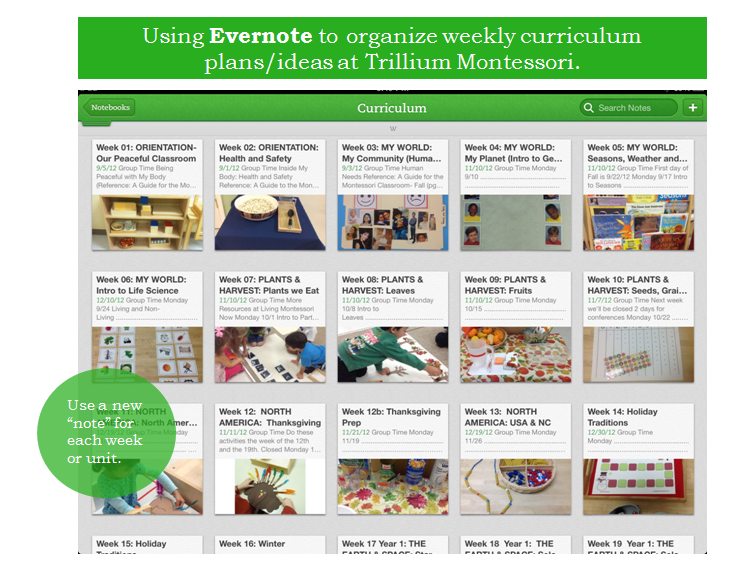
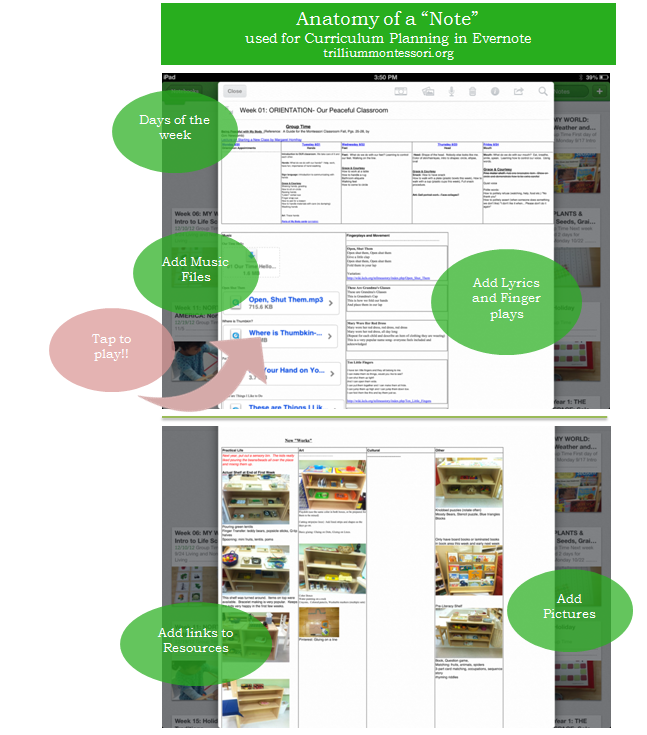
Evernote used to be my favorite planning tool. I loved how I could keep everything- lesson ideas, photos, audio notes, links, and even PDFs- on one page, in one “note”. It was especially helpful when planning on the go or switching between devices.
What I still appreciate about Evernote is the ability to combine multiple types of media in a single note. That kind of flexibility is hard to beat. If you already use it and it fits your workflow, it can still be a powerful tool.
That said, there are simpler and more intuitive options available now—especially if you’re just starting out. Tools like Google Drive, Trello, Notion, or Asana might be easier to learn and better supported these days. The key is to find something that helps you actually use the ideas and resources you’ve gathered—without getting bogged down in organizing the organizer.
If you like the images below, you will likely enjoy using Trello for organizing your plan.
Tips for Staying Grounded (and Not Collecting More Stuff!)
Once you start organizing your materials with a time-based plan, you may notice something surprising: you don’t need to collect as much as you thought. You begin to see what you actually use—and what just takes up space.
Here are a few tips that have helped me stay grounded and resist the urge to gather “just in case” items:
- Ask Yourself: When Will I Use This? This is the big question—the one that pulls you out of the three-dimensional mindset. If you can’t identify when you’ll use something, or where it fits in your year-at-a-glance plan, it might not be worth keeping.
- Check Your Grid Before You Buy: When you’re out and about and see something that feels like it would be perfect for your classroom, pause and think about your yearly plan. Ask:
- What unit would this fit into?
- When would I actually put it out?
- Do I already have something similar?
Sometimes the answer is “never,” and that’s okay.
- Build Units Around What You Already Own: Instead of choosing a theme and then going out to gather materials, try the reverse. Look at what you already have, and let that inspire your unit ideas. This is especially helpful if you’re trying to save money, reduce clutter, or just make use of the beautiful things you’ve collected over the years.
- Only Add What Inspires You: At this point in my career, I try to only create or buy new materials when I feel genuinely inspired. That’s helped me shift from collecting to curating—choosing fewer things, but ones I’m truly excited to use.
- Start Small if You’re New: If you’re just beginning your teaching journey, don’t try to do too much at once. You don’t need to have a full year of units planned right away. Start with a few seasonal themes or one unit per month and build from there. You’ll be surprised how quickly your resource library grows over time—with or without thrift store treasures.
A little structure goes a long way. When you know what’s coming up in your year, it’s easier to say no to random “finds,” to focus your planning time, and to bring out materials with confidence—because they have a place and a purpose.
Final Thoughts: Growing Over Time
Organizing in four dimensions isn’t about having the perfect plan or the most beautiful storage bins. It’s about making your work workable. It’s about freeing your mind from the weight of “someday” and giving your materials a clear place in the rhythm of your classroom.
If you’re new to this kind of planning, remember—you don’t have to do it all at once. Just begin with what you already have, make a simple map of your year, and build slowly. Each year, you’ll refine things, add new ideas, and get better at letting go of what no longer fits.
Over time, I’ve developed a library of units that I rotate through, tweak, and revisit. I don’t need to reinvent everything each year. I don’t need to keep everything. And I certainly don’t need to keep collecting things I might use someday.
Now, I focus on what inspires me—and what serves the children in front of me. That’s the real heart of the work.
So whether your closet is overflowing or you’re just getting started, I hope this approach gives you a little more clarity, a little more ease, and maybe even a little more space—on your shelves and in your mind.
You don’t need more stuff. You need a plan for the stuff you already have.
That’s organizing in four dimensions.