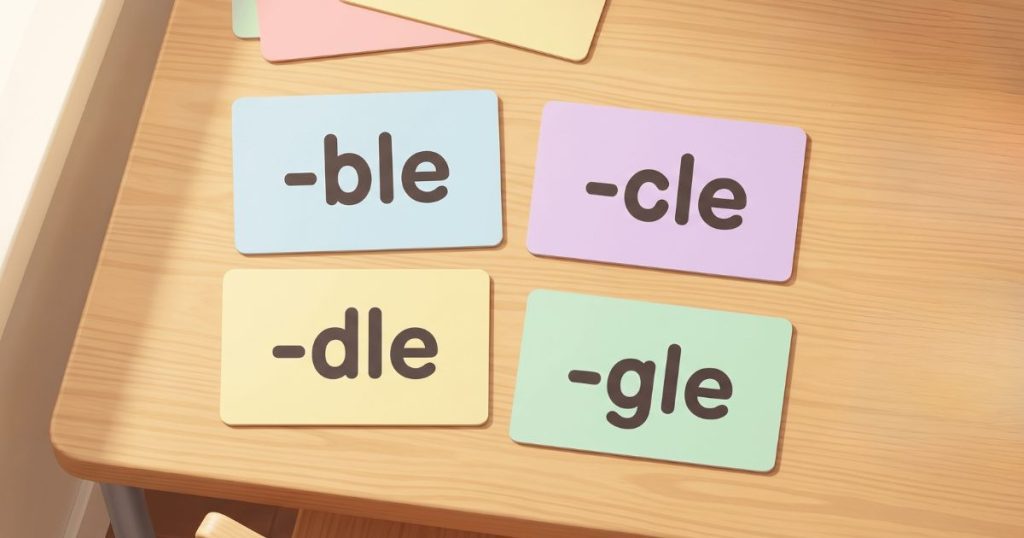
If you’re teaching multisyllabic words, consonant LE words are one of the most important patterns your students will encounter. Once they crack the code on this syllable type, longer words like stumble, pickle, and cradle stop being scary — they become predictable.
Quick Reference: Consonant LE Endings at a Glance
| Ending | Sound | Examples |
|---|---|---|
| -ble | /bul/ | bubble, table, cable |
| -dle | /dul/ | riddle, cradle, candle |
| -tle | /tul/ | battle, title, little |
| -gle | /gul/ | giggle, eagle, jungle |
| -ple | /pul/ | simple, maple, example |
| -fle | /ful/ | ruffle, rifle, baffle |
| -zle | /zul/ | puzzle, sizzle, dazzle |
| -ckle | /kul/ | pickle, freckle, buckle |
| -kle | /kul/ | ankle, twinkle, wrinkle |
| -cle | /kul/ | circle, uncle, miracle |
This post gives you everything you need: a clear explanation of the rule, organized word lists sorted by ending, and practical strategies for teaching this pattern explicitly.
What Are Consonant LE Words?
Consonant LE words (also written as C+LE or consonant+le) are words that end with a consonant letter followed by the letters l and e. The consonant+le chunk forms its own final syllable.
A few quick examples:
- bubble → bub • ble
- riddle → rid • dle
- simple → sim • ple
- pickle → pick • le
- cradle → cra • dle
The consonant+le syllable type is sometimes called a final stable syllable because it always appears at the end of a word and always behaves the same way, regardless of what comes before it.
The Key Rules for Consonant LE Words
Before diving into the word lists, make sure students understand these non-negotiable rules:
1. The E is always silent. The silent e doesn’t make the vowel in the first syllable long (as it does in VCe words). Its only job here is to serve as the written vowel in the syllable, because every syllable needs at least one written vowel.
2. The syllable produces a schwa sound. The consonant+le ending sounds like /ul/ — a reduced, unstressed vowel. This is why students often misspell these words, writing candol instead of candle or uncul instead of uncle. Explicitly teaching the /ul/ sound helps prevent this.
3. Consonant LE only appears at the END of words. It never starts a word or appears in the middle. This makes it easier to spot.
4. These are always multisyllabic words. A single-syllable word cannot carry a consonant+le ending.
5. The consonant before -le always goes WITH the -le syllable. When dividing the word, pull the consonant before -le to the right side. Never separate a -ck either: pickle divides as pick • le, not pic • kle.
How to Divide Consonant LE Words Into Syllables
The most reliable method for beginners: start at the end, count back three letters, and divide there.
Example: b-u-n-d-l-e → count back three from the end: d-l-e → divide before the d → bun • dle
Once students recognize consonant+le endings automatically, they’ll divide with fluency. But the count-back-three method is a reliable scaffold while they’re learning.
After dividing, students look at the first syllable to determine if the vowel is long or short:
- If the first syllable ends in a vowel (open syllable), the vowel says its long sound → cra • dle, ti • tle, ta • ble
- If the first syllable ends in a consonant (closed syllable), the vowel says its short sound → bun • dle, sim • ple, puz • zle
The Doubling Rule for Consonant LE Words
This is one of the trickier encoding concepts. When the vowel in the first syllable is short and the same consonant sound begins the -le syllable, the consonant is doubled.
| Short vowel → doubled consonantLong vowel → no double | |
|---|---|
| bubble | table |
| middle | cradle |
| giggle | eagle |
| battle | title |
| puzzle | rifle |
Teaching this pattern explicitly helps students make the connection between vowel sound and spelling — and stops the common error of writing buble or midle.
Consonant LE Words: Complete Word Lists by Ending
The consonant endings that appear before -le include: -ble, -dle, -tle, -gle, -ple, -fle, -zle, -ckle, -kle, and -cle.
-BLE Words
Two-syllable -ble words (short vowel / closed first syllable): bubble, dabble, dribble, fumble, gobble, grumble, hobble, humble, jumble, mumble, nibble, pebble, rabble, rubble, rumble, scribble, stumble, thimble, tremble, tumble, wobble
Two-syllable -ble words (long vowel / open first syllable): able, cable, fable, sable, stable, table
Three-syllable -ble words: capable,erable, feeble, horrible, possible, probable, vegetable
-DLE Words
Short vowel / closed first syllable: cuddle, dawdle, diddle, fiddle, griddle, huddle, middle, muddle, paddle, piddle, puddle, riddle, saddle, toddle
Long vowel / open first syllable: bridle, candle, cradle, dwindle, handle, kindle, needle, noodle, poodle, spindle, swindle
Three-syllable -dle words: doodle, meddle, straddle, twaddle
-TLE Words
Short vowel / closed first syllable: battle, bottle, brittle, cattle, kettle, little, nettle, rattle, settle, shuttle, tattle, title, whittle
Long vowel / open first syllable: title
Silent T (special case): castle, hustle, bustle, jostle, rustle, trestle, whistle, wrestle
Note: When s comes before -tle, the t is silent. This is a historical pronunciation shift worth teaching explicitly so students aren’t confused when they hear these words spoken.
-GLE Words
Short vowel / closed first syllable: giggle, goggle, jiggle, juggle, muggle, ogle, snuggle, squiggle, struggle, wiggle, wriggle
Long vowel / open first syllable: beagle, eagle
Blends before -gle: angle, bangle, bungle, dangle, gargle, jangle, jungle, mangle, mingle, ogle, rectangle, single, tangle, tingle, wrangle
-PLE Words
Short vowel / closed first syllable: cripple, nipple, ripple, supple, tipple, topple
Long vowel / open first syllable: maple, staple
Blends before -ple: ample, dimple, example, pimple, sample, simple, temple, trample, tremble
-FLE Words
Short vowel / closed first syllable: baffle, duffle, muffle, raffle, ruffle, scuffle, shuffle, snuffle, truffle, waffle
Long vowel / open first syllable: rifle, stifle, trifle
Blends before -fle: baffle, ruffle, shuffle, sniffle, trifle, whiffle
-ZLE Words
Short vowel / closed first syllable: dazzle, drizzle, fizzle, frazzle, nuzzle, puzzle, sizzle, snizzle
Long vowel / open first syllable: dazzle, muzzle
-CKLE Words
These words always have a short vowel in the first syllable because -ck signals a closed syllable:
buckle, chuckle, crackle, freckle, fickle, knuckle, pickle, prickle, shackle, spackle, sparkle, speckle, sprinkle, tackle, tickle, trickle, twinkle, wrinkle
-KLE Words (without the c)
ankle, rankle, crinkle, tinkle, wrinkle
-CLE Words
article, barnacle, bicycle, circle, cubicle, icicle, miracle, muscle, obstacle, oracle, particle, spectacle, tentacle, tricycle, uncle, vehicle
5 Effective Strategies for Teaching Consonant LE Words
1. Color-Code the Syllables
Give students a word list and two different colored highlighters or crayons. Have them mark the C+LE syllable in one color and the first syllable in another. This activity builds visual recognition of the pattern and makes the syllable boundary concrete. Ask students what they notice — they’ll identify on their own that the C+LE chunk always comes last.
2. Teach the Schwa Sound Directly
Students frequently misspell these words because the schwa /ul/ doesn’t sound like any letter they know. Teach them explicitly: “When you hear /ul/ at the end of a word, write the consonant you hear plus the letters l-e.” Pair this with direct instruction on the doubling rule so they know when to double. Flash cards with just the C+LE endings (-ble, -dle, -tle, etc.) are useful here — hold one up and have students say “b-l-e says /bul/.”
3. Word Sorts
Sorting is one of the most powerful practice activities for this pattern. Try these sort variations:
- Sort by ending: group all -ble words, -dle words, -tle words, etc.
- Sort by first-syllable vowel sound: open (long vowel) vs. closed (short vowel)
- Sort by whether the consonant doubles: bubble vs. table, middle vs. needle
Sorting forces students to analyze word structure rather than passively read, which builds deeper understanding.
4. Word Chains
Word chains build both fluency and flexibility. Start with a consonant LE word and change one syllable at a time:
- cable → fable → table → stable → staple → maple
- rubble → bubble → fumble → tumble → ramble
This activity works especially well on a whiteboard where you can erase one syllable at a time, making the structure of the word visible.
5. Practice in Decodable Text
Once students can decode C+LE words in isolation, move them into decodable passages. Before reading, have students scan the text and circle any consonant LE words they spot. They can divide those words into syllables right on the page before reading, which reduces cognitive load during actual reading. After reading, revisit the words and discuss how the pattern helped them decode.
When to Teach Consonant LE Words
Most structured literacy programs introduce consonant LE after students have solid footing with open, closed, and VCe syllables. Students are ready if they can:
- Decode 2-syllable words with open and closed syllables
- Identify open vs. closed syllables
- Read and spell basic CVC and CVCe words fluently
Some programs (like UFLI) introduce it as an ending spelling pattern relatively early, while others (like IMSE) wait until after vowel teams and r-controlled vowels. The specific sequence matters less than ensuring the foundational syllable types are in place first.
Quick Reference: Consonant LE Endings at a Glance
| Ending | Sound | Examples |
|---|---|---|
| -ble | /bul/ | bubble, table, cable |
| -dle | /dul/ | riddle, cradle, candle |
| -tle | /tul/ | battle, title, little |
| -gle | /gul/ | giggle, eagle, jungle |
| -ple | /pul/ | simple, maple, example |
| -fle | /ful/ | ruffle, rifle, baffle |
| -zle | /zul/ | puzzle, sizzle, dazzle |
| -ckle | /kul/ | pickle, freckle, buckle |
| -kle | /kul/ | ankle, twinkle, wrinkle |
| -cle | /kul/ | circle, uncle, miracle |
Consonant LE words follow a consistent, teachable pattern — and once students internalize the rule, longer words become far less intimidating. Use the word lists above for sorting, dictation, fluency practice, and word chains, and pair them with the strategies in this post for a complete approach to this syllable type.
Free Guide: Consonant + le Words: Lists and Strategies Downloadable PDF
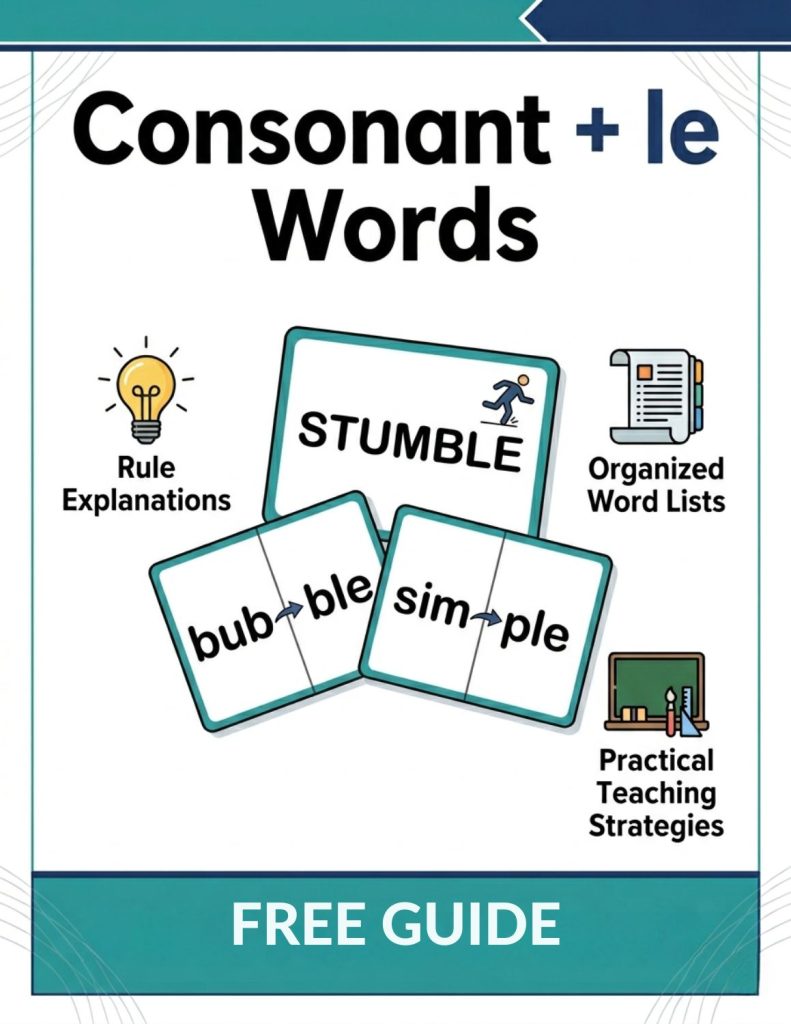
This guide provides a clear roadmap for teaching consonant + le words by focusing on explicit rules and syllable division strategies. It includes organized word lists for all ten endings and practical strategy ideas like word chains and color-coding to help students decode final stable syllables with ease.