By Pauline Meert
A few months ago, I read an article on sharing that led to a lot of discussions and thinking. The article “Some Parenting Rules are Meant to be Broken” by Beth W. from Very Bloggy over on sunnyskyz.com discusses her experience with “sharing”.
Through examples of two experiences, one in a park where a child expects to get someone else’s toy because he wants it and one where she and her child are in a common play area and she overhears a mom complaining that she is not forcing her child to share the toy he is playing with, Beth illustrates her view that sharing should not be forced. The comments illustrate a wide range of points of view, from people agreeing, to others arguing that children must be forced to share and others screaming for a good spanking.
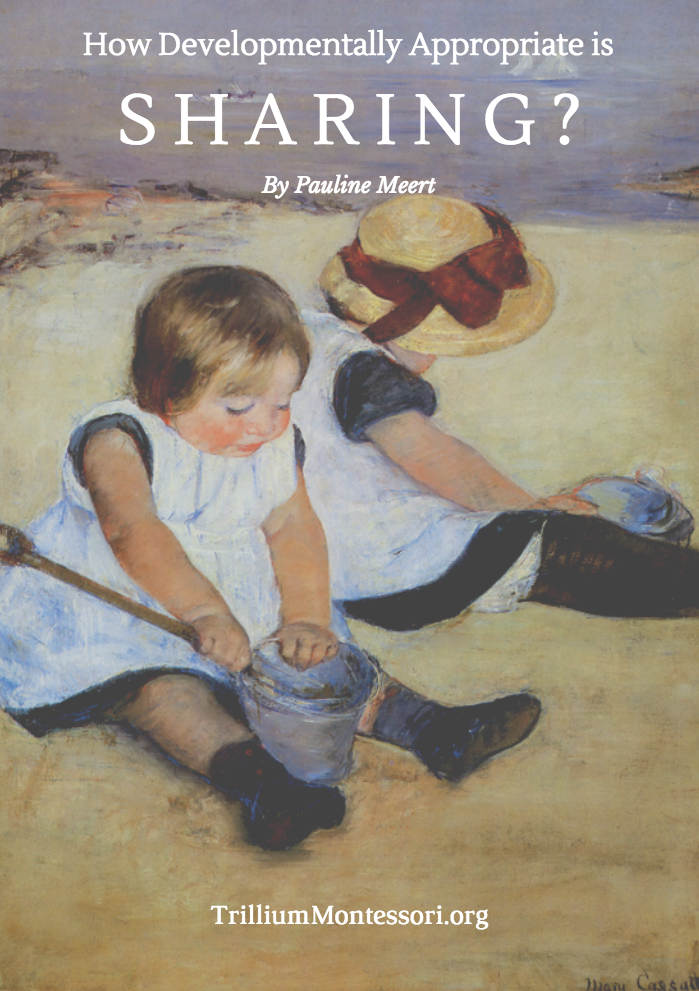
Sharing is a very interesting topic. As adults we want children to be generous, self-sacrificing, and aware of other people’s needs and desires. These are very adult virtues or concepts and take time and practice to learn. Young children are not born with the innate ability to know what others want or need or to be selfless. They are still figuring these things out for themselves!
Planes of Development
Maria Montessori found that children develop through four primary planes of development- ages 0-6, 6-12, 12-18, and 18-24. Each plane of develop has a specific point and purpose.
To learn more about the planes of development, check out these resources by Montessori Training.
For our purpose, we will focus on the 0-6 plane of development where parents and teachers most often spend a lot of time focusing on sharing. This is the time of the absorbent mind. It is when a child learns about himself and his environment through active interactions.
The 0-6 plane is separated into two sections, the unconscious (0-3 years of age) and the conscious (3-6 years of age) stages. The unconscious stage is solely focused on the construction of self (learning who they are in relations to their environment). Children in this stage are not yet able to take into account another person’s actions/choices/desires. They are naturally very selfish but in the right way (in a matter of constructing themselves, unlike us adults who act selfishly out of self-interest).
The concept of sharing can seem very alien to children under the age of three. Now as a child gets older, it becomes more appropriate to encourage sharing (though it should still stem from an intrinsic desire to care for others and not be forced). The 3-6 children in my classroom often surprise me and blow my mind with their ability to share with others and care for each other.
How to Teach Sharing
So what do we do about it?
Set an Example
Living your life in an atmosphere of sharing and selflessness is a great way to start. As the child absorbs from his environment, he or she is exposed to and thus absorbs the values of the surrounding culture. The values will of course not be evident but we must trust in the child and the absorbent mind! Values can also be taught and practiced. In Montessori classrooms we teach Grace and Courtesy lessons with care, respect, and cultural responsiveness. Lessons may include how to wait your turn, how to ask for a lesson, how to serve a snack to others, and many more. Through these lessons children learn to use their freedom and make choices within a community.
Build Community
When children have choices and the ability to control their actions and are taught grace and courtesy, they start to act in a more communal and loving way. This gives them a safe base. If we adults are the ones in charge of all this (deciding who gets what, when, where, for how long, when it’s time to share, etc…) children feel a loss of control and “sharing becomes an extrinsic concept. What we really want is for children to see others who are alone or without a toy and be able to share out of intrinsic love and concern. we want sharing to happen naturally and lovingly. If it is forced, extrinsic, and adult controlled, it is far less likely to happen this way.
Pitfalls
Another topic discussed in the article is that of “hoarding”. Hoarding can sometimes stem from being constantly forced to share– having an adult establish how long you can play with your things, who gets what, and taking things away at their discretion. This can make the child feel that he cannot have thing and will thus try to “hoard” them away from others. This is not good, and not balanced. When a child knows that he can work with a material for as long as he wants, he feels safe and secure in his work and concentration. For example, I have seen children come into the classroom who would “hoard”. They would stay with a work not out of concentration but out of selfishness and not wanting others to have it. This, I think, comes from not having the ability to be in charge of how they share or how long they spend with something. Through grace and courtesy (other children asking for their turn or asking to being notified when he is done) and more time in the classroom where they can work with something for as long as they want, their hoarding behavior starts to disappear. Donna Goertz has a great book filled with stories like this- Children Who Are Not Yet Peaceful
When re-reading a few of the comments below the article where people are adamant that “sharing” has to be forced/imposed, one can clearly see that there is a lack of understanding of the stages of development a child goes through. There is a better way. That way is to follow a child’s growth and development within freedom, independence, discipline, ground rules/boundaries, modeling through grace and courtesy lessons, and choices. What I continue to find most groundbreaking about what Maria Montessori did is that she looked to the child first. Everything she implemented (the materials, the environment, the way the teacher acts, the method) came from taking the time to observe the child and we must do the same!
About Pauline Meert

Pauline Meert is the lucky teacher to twenty wonderful children in a beautiful Montessori classroom. She enjoys making new materials and discussing Montessori with strangers. She can be found at
For Little Ones: Pauline’s Etsy store where you can find her handmade books
Montessori Geek: Pauline’s Blog
Pauline’s Pinterest Boards