Tropical rainforest plants include canopy trees such as kapok and rubber trees, climbing vines, palms, and epiphytes such as many bromeliads. They compete for sunlight and cope with frequent rain and warm temperatures. This guide shows plant examples from tropical rainforests around the world, with photographs, habitats, and adaptations. Temperate rainforests have different plant communities.

Trees of the Rainforest Biome
Kapok Tree

The Kapok tree is one of the tallest trees in the Amazon, often growing over 200 feet high. Its huge trunk and wide roots help support it in the shallow rainforest soil. This tree is very important for many animals, providing them with both shelter and food.
- Average Size: Typically grows to about 150 feet, but it can reach heights of over 200 feet
- Is Eaten By: Various animals, including monkeys and birds, eat the flowers and seeds of the Kapok tree
- Region/Continent: Found in tropical regions, mainly in South America, particularly in the Amazon Rainforest
- Classification: Ceiba pentandra
Rubber Tree

The Rubber tree is important because it produces latex, the main source of natural rubber. Latex is collected by cutting the tree’s bark and letting it flow out. Indigenous people have used this tree for centuries, and it helped start the global rubber industry.
- Average Size: Usually grows to about 100 feet tall
- Is Eaten By: The leaves and seeds are sometimes eaten by insects and small mammals
- Region/Continent: Native to the Amazon Rainforest in South America
- Classification: Hevea brasiliensis
Sangre de Drago

Sangre de drago, or dragon’s blood (Croton lechleri), is a tropical South American tree known for its reddish latex. The name “dragon’s blood” is also used for unrelated plants. Its traditional uses should not be confused with proof that the raw sap treats diseases.
- Average Size: Grows to heights of around 50 to 70 feet
- Is Eaten By: Not a primary food source for any particular animal, but some insects may feed on its leaves or sap
- Region/Continent: Found in the Amazon Rainforest, primarily in South America
- Classification: Croton lechleri
Walking Palm

The walking palm (Socratea exorrhiza) has conspicuous stilt roots that support its trunk as it grows. Despite its common name, there is no established evidence that a mature palm walks across the forest floor toward sunlight. Research links its stilt-root structure to vertical growth and mechanical stability.
- Average Size: Typically grows to about 50 to 80 feet tall
- Is Eaten By: Various insects and some mammals may eat its fruit and leaves
- Region/Continent: Central and South America, particularly in the Amazon Rainforest
- Classification: Socratea exorrhiza
Cecropia Tree

Cecropia trees have a symbiotic relationship with ants that live in their hollow stems and protect the tree from animals that want to eat it. The tree’s large, hand-shaped leaves are easy to recognize. These trees grow quickly and are among the first to appear in areas where the forest has been disturbed.
- Average Size: Grow to about 30 to 60 feet tall
- Is Eaten By: Sloths and birds eat the leaves and fruit of the Cecropia tree
- Region/Continent: Central and South America, particularly in the Amazon Rainforest
- Classification: Cecropia spp
Afromosia

Afromosia, also called African teak, is prized for its strong and beautiful wood. This large tree with a straight trunk grows in the thick rainforests of Central Africa. Because people have cut down too many of these trees, it is now considered an endangered species.
- Average Size: Grows up to 164 feet tall
- Is Eaten By: Insects and fungi
- Region/Continent: Found in the dense rainforests of Central Africa
- Classification: Pericopsis elata
Cinchona Tree

The bark of the Cinchona tree is where quinine comes from, which was the main treatment for malaria in the past. Discovering and using this tree has greatly impacted global health. Today, the bark is still used to make tonic water and medicines.
- Average Size: Typically grow to about 50 to 80 feet tall
- Is Eaten By: Usually not eaten due to its bitter taste
- Region/Continent: Tropical Andean regions of South America
- Classification: Cinchona spp
Flowers of the Rainforest
Victoria Amazonica

The Victoria Amazonica is a giant water lily with leaves that can grow up to 10 feet wide and are strong enough to hold a small child. Its flowers bloom at night and change from white to pink after being pollinated. This beautiful plant is a highlight of Amazonian rivers and lakes, providing a home for many water creatures.
- Average Size: Leaves can grow up to 10 feet in diameter
- Is Eaten By: Sometimes eaten by fish and other aquatic animals
- Region/Continent: Amazon Basin in South America
- Classification: Victoria amazonica
Corpse Flower
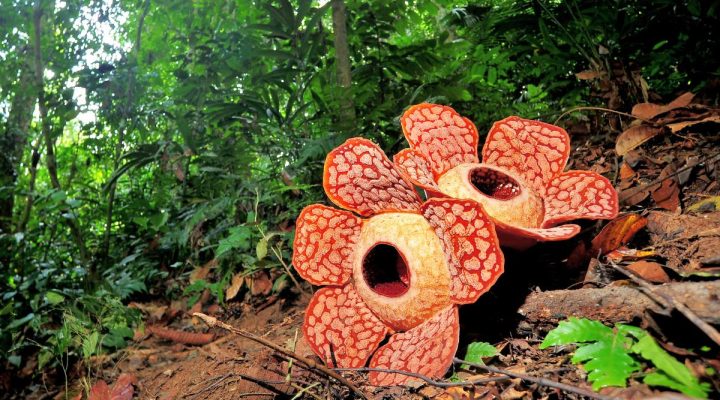
Rafflesia arnoldii, often called a corpse flower, produces an enormous individual flower that smells like rotting meat and attracts pollinating flies. It lives as a parasite inside Tetrastigma vines in the rainforests of Sumatra and Borneo, not New Guinea.
- Average Size: The flower grows up to 3 feet in diameter
- Pollination: Carrion flies are attracted by the flower’s odor and carry pollen between flowers; pollination is different from eating the plant.
- Region/Continent: Sumatra and Borneo in Southeast Asia.
- Classification: Rafflesia arnoldii
Heliconia

Heliconias have conspicuous, often red or orange bracts surrounding smaller flowers. Many species are pollinated by hummingbirds. They grow in tropical habitats, with light requirements varying by species.
- Average Size: Typically grow to about 3 to 15 feet tall
- Is Eaten By: Insects, birds, and small mammals, may feed on the nectar, fruits, and leaves
- Region/Continent: Central and South America, particularly in the Amazon Rainforest
- Classification: Heliconia spp.
Bromeliads

Bromeliads are a diverse plant family. Many rainforest species grow on trees as epiphytes, while others grow in soil. Some have leaf rosettes that collect rainwater, creating small habitats for insects, frogs, and other organisms.
- Average Size: Range from 6 inches to 3 feet tall
- Is Eaten By: Insects and birds eat the leaves, flowers, and nectar
- Region/Continent: Central and South America, particularly in the Amazon Rainforest.
- Classification: Bromeliaceae
Giant Water Lily

“Giant water lily” is a common name used for species of Victoria. The Amazon water lily (Victoria amazonica) is also described above, so these entries refer to the same plant rather than two distinct species. Its large floating leaves and night-opening flowers are characteristic features.
- Average Size: Leaves grow up to 10 feet in diameter
- Is Eaten By: Fish and insects eat parts of the lily, including its leaves and seeds
- Region/Continent: Amazon Basin in South America.
- Classification: Victoria amazonica (the Amazon giant water lily).
Passionflower

Passionflowers are climbing plants with distinctive, intricate flowers. Some species produce edible passionfruit, while their leaves support certain butterfly caterpillars. Different species have different properties; they should not be treated as interchangeable foods or remedies.
- Average Size: Vines can grow up to 10 to 30 feet long
- Is Eaten By: Butterflies and caterpillars feed on the leaves, while birds and mammals eat the fruit
- Region/Continent: Subtropical regions of the Americas, including the Amazon Rainforest
- Classification: Passiflora spp
Fruits of the Rainforest
Açaí Palm

The açaí palm produces small, dark purple fruits harvested in the Amazon’s floodplains. Birds and other animals eat the fruits and help disperse the seeds. The palm has a slender trunk topped by long, feathery leaves.
- Average Size: Typically grows to about 50 to 80 feet tall
- Is Eaten By: The berries are eaten by birds and monkeys and humans
- Region/Continent: Amazon Rainforest in South America
- Classification: Euterpe oleracea
Guarana

Guarana is a climbing plant famous for its seeds, which have double the caffeine found in coffee beans. People use these seeds to make energy drinks and supplements. Indigenous tribes have been using Guarana’s stimulating effects for a long time.
- Average Size: Grow to be about 10 to 12 feet tall
- Is Eaten By: Seeds eaten by birds and small mammals
- Region/Continent: Amazon Rainforest in South America
- Classification: Paullinia cupana
Pineapple

Although not only found in the Amazon, the Pineapple originally comes from South America and grows well in the rainforest. Its sweet and spiky fruit is famous all around the world. People grow Pineapples both in wild areas and on farms in the region.
- Average Size: Typically grow to be about 3 to 5 feet tall
- Is Eaten By: Birds, humans, rodents, and insects
- Region/Continent: Pineapples are native to South America
- Classification: Ananas comosus.
Annatto

Annatto, also called achiote, is a tropical shrub or small tree. Its seed coating supplies a red-orange color used in foods and dyes. The plant is grown in tropical regions, including parts of the Americas.
- Average Size: Grow to be about 6 to 20 feet tall
- Is Eaten By: Birds and rodents eat the seeds
- Region/Continent: Central and South America, including parts of the Amazon Rainforest
- Classification: Bixa orellana
Cocoa Tree

The Cocoa tree grows in the Amazon basin and gives us cacao beans, which are the main part of chocolate. Its scientific name, Theobroma cacao, means “food of the gods,” showing how special it is. Inside the tree’s pods are seeds that are fermented, dried, and made into chocolate.
- Average Size: Grow to be about 15 to 25 feet tall
- Is Eaten By: Eaten by various animals, including rodents, monkeys, and birds
- Region/Continent: Amazon basin in South America
- Classification: Theobroma cacao
Brazil Nut Tree

The Brazil nut tree can reach heights of up to 160 feet and produces big fruits with seeds inside. These seeds, called Brazil nuts, are important for trade. Specific kinds of bees help pollinate the tree, showing how different species in the Amazon depend on each other.
- Average Size: Grows up to 160 feet tall, making it one of the tallest trees in the Amazon Rainforest
- Is Eaten By: Eaten by various animals, including rodents, agoutis, and monkeys
- Region/Continent: Amazon Rainforest in South America
- Classification: Bertholletia excelsa
Vines of the Rainforest
Tetrastigma

Tetrastigma is a genus of climbing plants in the grape family, Vitaceae. These vines use tendrils for support and make their own food through photosynthesis. Some species are hosts for parasitic Rafflesia; it is the parasite, not the vine, that takes water and nutrients from a host.
- Average Size: Varies by species; many are long, woody climbers.
- Ecological Role: Some Tetrastigma species serve as hosts for parasitic Rafflesia plants.
- Region/Continent: Various rainforest regions across Asia
- Classification: Tetrastigma spp., family Vitaceae.
Cat’s Claw

Cat’s claw (Uncaria tomentosa) is a woody vine from tropical Central and South America. Its curved hooks help it climb other plants. It has a history of traditional use, but clinical evidence does not establish it as an effective treatment for any health condition.
- Average Size: Can grow to be about 30 to 50 feet long when fully mature
- Is Eaten By: Monkeys and birds eat the leaves and fruits
- Region/Continent: Amazon Rainforest in South America
- Classification: Uncaria tomentosa
Strangler Fig

The Strangler Fig begins its life by growing on another tree, but then it takes over by surrounding and outgrowing it. This makes a kind of empty space inside made of roots and branches. Many animals rely on these figs for food, eating the fruit they produce.
- Average Size: Vary widely in size depending on the species, but they can grow to be over 100 feet tall
- Is Eaten By: Fruits are eaten by birds, bats, and monkeys
- Region/Continent: Tropical and subtropical regions worldwide, including the Amazon Rainforest in South America
- Classification: Ficus spp
Lianas

Lianas are long, strong vines found in places like the Congo Rainforest. They wrap around trees to climb up towards the sunlight. Lianas grow really long and make important pathways for animals in the forest, helping lots of different plants and creatures live together.
- Average Size: Can grow to several hundred meters in length
- Is Eaten By: Not typically eaten by animals
- Region/Continent: Worldwide, including the Congo Rainforest in Central Africa.
- Classification: Various species belong to different plant families
Adaptations of Rainforest Plants
Tropical rainforest plants have adaptations that help them obtain light, cope with frequent rain, and interact with animals. Different species use different strategies; the examples below do not apply to every rainforest plant.
- Living on Other Plants: Some plants don’t grow in the ground; instead, they hitch a ride on other plants, like trees, so they can reach the sunlight. This way, they can thrive even if the forest floor is too dark and crowded.
- Pointy Leaves: To deal with all the rain in the rainforest, many plants have leaves with pointy tips. These pointy ends help water slide off quickly, so the leaves don’t get weighed down or damaged by too much moisture.
- Buttress Roots: Some large rainforest trees have broad, flared roots that help support tall trunks. Buttresses can increase stability where roots spread through relatively shallow soil.
- Climbing Plants: Lianas and vines are like nature’s climbers; they use trees as their ladders to reach higher up where there’s more sunlight. By climbing up other plants, these vines can grow taller and compete better for sunlight.
- Stilt Roots: Palms such as Socratea exorrhiza have roots that extend from the trunk to the ground and provide support as the palm grows. They are not evidence that the tree walks toward light.
- Chemical Weapons: Many plants in the rainforest make chemicals that taste bad or even hurt animals that try to eat them. This helps the plants protect themselves from being eaten by hungry animals looking for a snack.
- Darkness Survivors: Plants on the forest floor have big leaves that help them soak up as much sunlight as possible. Even though it’s shady down there, these big leaves help them make the most of the little light they get.
- Grow Fast: Some trees in the rainforest grow really quickly to reach the sunlight before other plants. By growing fast, these trees can shoot up and get ahead in the competition for sunlight.
- Making Friends: Plants in the rainforest sometimes team up with animals to help each other out. For example, some plants provide shelter or food for animals, while the animals help spread the plant’s seeds.
- Leaf Surfaces: Some rainforest plants have waxy leaf surfaces that help shed water. Combined with leaf shape and drip tips, these surfaces can reduce the time water remains on leaves.
These adaptations help rainforest plants stay strong and keep the Amazon buzzing with life!
Ecological Importance
The plants of the Amazon Rainforest are not just vital for their own ecosystem but for the entire planet. Here’s why:
- Carbon Storage
Rainforest plants absorb carbon dioxide during photosynthesis and store carbon in living tissues. How much carbon a forest stores depends on growth, decay, fire, and land use; deforestation releases stored carbon. It is not accurate to assume every part of the Amazon is always a net carbon sink.
- Biodiversity
The Amazon Rainforest has a huge variety of plants and animals, making it one of the most complex ecosystems on Earth. This variety of life is called biodiversity. Biodiversity is very important because it helps the ecosystem stay strong and healthy. When there are changes or problems in the environment, a diverse ecosystem can recover better. This means the Amazon can continue to support many species even when things go wrong.
- Water Cycle Regulation
Plants in the Amazon Rainforest play an important role in the global water cycle. Through a process called transpiration, trees release water vapor into the air. This water vapor helps create clouds and rain, keeping the region’s weather patterns stable. The rainforest’s influence on rainfall also affects weather systems around the world. This shows how connected our planet’s climate really is.
Be sure to visit The Rainforest Biome for many more resources for a study of the Rainforest Biome.
Conservation Challenges and Efforts
- Sustainable Practices
To protect the Amazon Rainforest, we need to use practices that don’t harm it. One way is through sustainable farming and forestry, where we grow crops and trees in a way that keeps the forest healthy. Agroforestry is a cool idea that mixes trees and crops, helping both the environment and the people who live there.
- Protected Areas and Indigenous Rights
We have to make sure parts of the Amazon are off-limits to things like logging and farming. This means creating special protected areas where plants and animals can live safely. It’s also important to respect the rights of the indigenous people who have lived in the rainforest for a long time; they know how to take care of it best.
- Global Initiatives
People from all over the world need to work together to save the Amazon. There are big projects and programs that get money from different countries and groups to help protect the rainforest. By teaming up with organizations and governments, we can make sure the Amazon stays healthy for the future.