House Spider vs Brown Recluse Spider: although these two arachnids have very different habits and lifestyles, they are frequently confused for one another. Understanding their unique traits helps people identify which spider is essentially harmless to humans, and which to avoid.
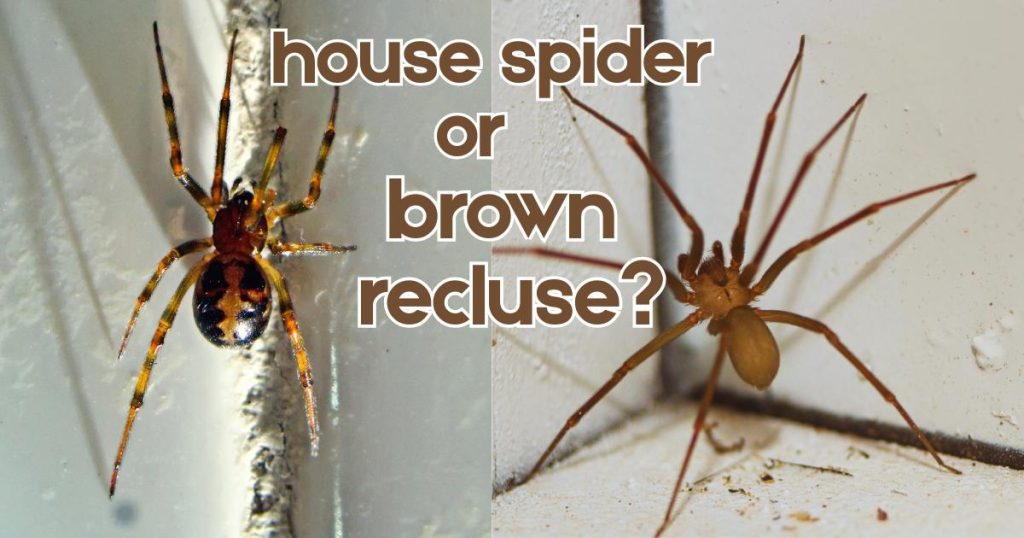
House Spider vs Brown Recluse: What is the Difference?
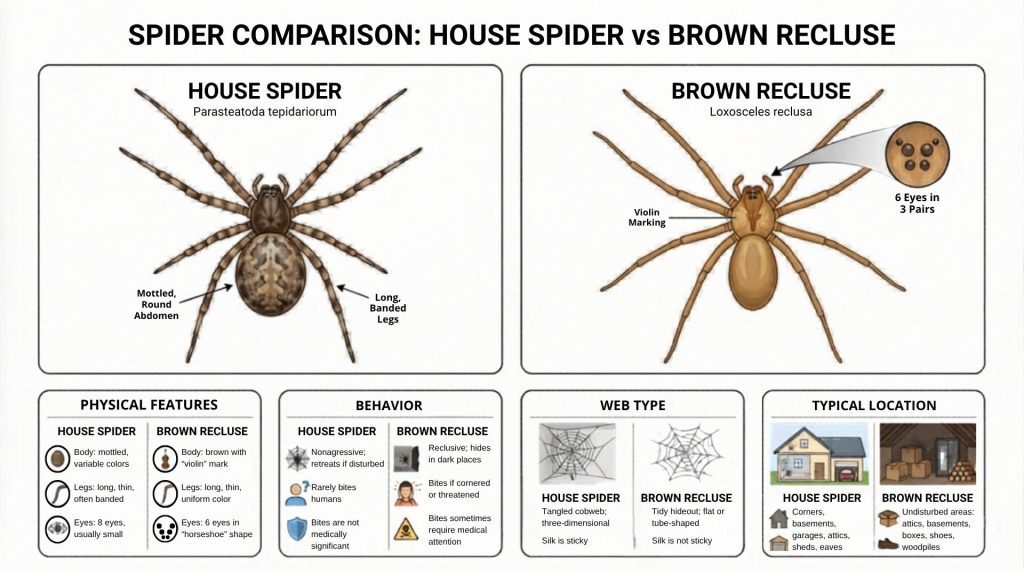
- The House Spider’s scientific name is Parasteatoda tepidariorum. The Brown Recluse’s scientific name is Loxosceles reclusa.
- House Spiders build messy, tangled webs to catch prey. Brown Recluse Spiders are active hunters that use webs to hide but rarely use webs for trapping food.
- House Spider silk is sticky; Brown Recluse silk is not.
- House Spiders have eight eyes arranged in two rows. Brown Recluse Spiders have only six eyes arranged in three pairs.
- The House Spider has striped or banded legs. The Recluse has solid-colored brown legs with no markings.
- Brown Recluse Spiders have a distinctive “violin” shaped mark on the top of their body near their head.
- House Spider bites are essentially harmless to humans. Brown Recluse Spider bites sometimes cause serious reactions requiring medical attention.
Physical Appearance
Size and Build
The House Spider is small, with females reaching about 0.25 inches in body length. Brown Recluse spiders are slightly larger, typically measuring 0.25 to 0.5 inches long. Both species are lightweight and weigh less than one gram.
Coloring and Markings
House spiders are usually dull brown with spotted or chevron patterns on their abdomens. Brown Recluse spiders are tan to dark brown with a very specific dark, violin-shaped mark. This “fiddle” mark sits on the top of their front body segment.
Distinctive Eye Patterns
House Spiders have eight eyes that allow them to detect movement in their webs. Brown Recluse spiders are unique because they only have six eyes. These eyes are grouped into three pairs shaped like a small horseshoe.
Habitat and Range
Geographical Range
The House Spider is found throughout North America.
Brown Recluse spiders live in a smaller area, mostly in the central and southeastern United States. They do not naturally live in the western or northern coastal states.
Preferred Habitat
House Spiders love high corners, basements, and sheds where they can hang their webs.
Brown Recluse spiders prefer dark, undisturbed areas like attics, woodpiles, closets, or infrequently-worn shoes, or inside cardboard boxes. They tend to stay away from humans whenever possible.
Behavior and Diet
Behavior
House Spiders are not especially territorial. In general, they are social enough to build webs near each other, sometimes filling a corner with several sticky cobwebs.
Brown Recluse Spiders are solitary hunters, often wandering at night to find food. They are shy and usually only bite if they are accidentally squeezed against skin.
Web Style
The House Spider creates a classic, tangled, sticky “cobweb” designed to snag flying insects.
In contrast, the Brown Recluse builds a flat, silk retreat used only for resting or hiding. Brown Recluse silk is not sticky and is not used for hunting.
Diet
House Spiders eat common household pests like flies, mosquitoes, and ants that fly into their webs and become stuck.
Brown Recluse Spiders hunt crawling insects and may even scavenge on dead bugs they find. Both species help keep indoor insect populations under control.
Reproduction and Lifespan
Mating and Offspring
House Spiders lay several brown, pear-shaped egg sacs that can hold hundreds of eggs. Brown Recluse Spiders lay flat, silken cases containing about 40 to 50 eggs. Mothers in both species often stay near their eggs to protect them from predators.
Lifespan
In the wild, House Spiders usually live for about one year. Brown Recluse Spiders are hardier and can live for two to four years. In controlled lab settings, some recluse spiders have lived for over five years.
Human Safety and Precautions
House Spider bites are not medically significant. If detected at all, the House Spider’s bite feels like a tiny pinprick.
The Brown Recluse’s bite is more serious, with venom that can cause skin damage or a slow-healing sore. To stay safe and avoid contact with Brown Recluse Spiders, shake out old shoes before wearing them, check woodpiles carefully when removing wood, and wear gloves when moving boxes or other items that have been in storage.
Cultural Significance
Spiders are sometimes used as symbols of patience, persistence, and luck because of their webs. However, spiders are also often feared in modern media, appearing as monsters in horror movies. The Brown Recluse in particular is a common subject of harrowing tales (some true, some urban legends) regarding bite severity.
Conservation Status
The House Spider is a species of Least Concern because it is very widespread. The Brown Recluse Spider is also considered a species of Least Concern as their populations are stable. Neither spider is currently at risk of extinction or environmental threat.