Manta rays are large filter-feeding rays with paired cephalic fins beside the mouth and no stinging tail spine. Many other stingrays feed near the bottom and have a defensive tail spine. Size and habitat vary, so use several features to compare these related cartilaginous fishes.
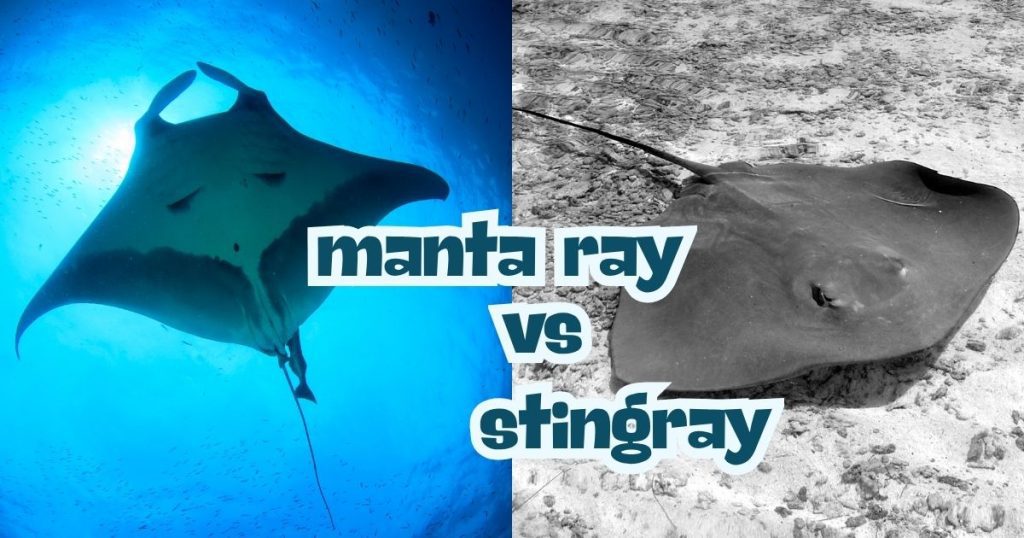
Manta Ray vs Stingray: How to Tell the Difference
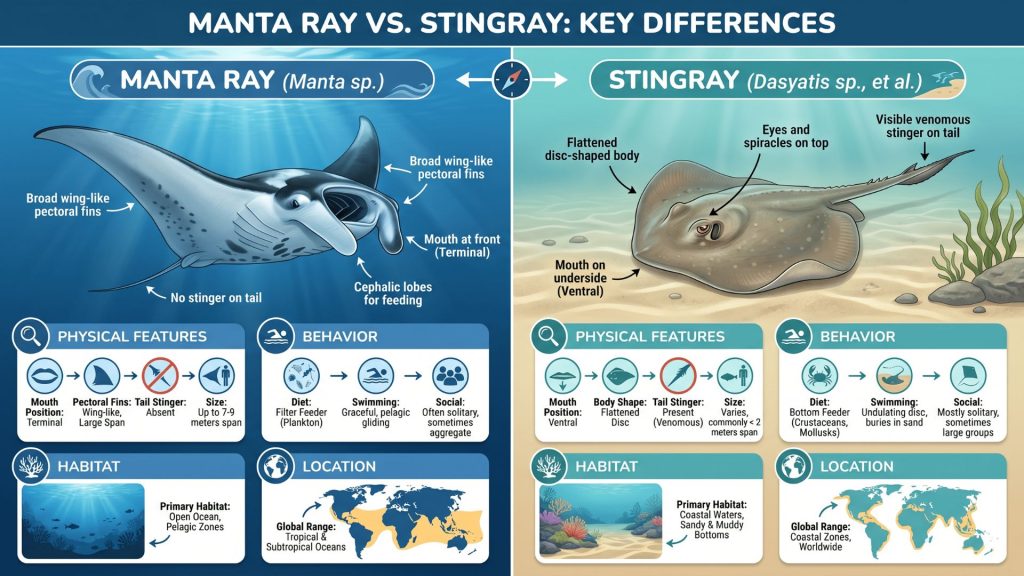
Quick Reference: Manta Ray vs Stingray at a Glance
| Feature | Manta Ray | Stingray |
|---|---|---|
| Size | 18–23 ft wingspan (giant manta) | 6 inches to 6.5 ft across |
| Tail | Long, whip-like — NO stinger | Long, whip-like — HAS a venomous stinger |
| Cephalic fins | Yes — two horn-like fins on head | No horn-like fins |
| Mouth position | Front-facing (terminal) | Underneath the body |
| Habitat | Open ocean, near surface | Coastal waters, sandy/muddy bottoms |
| Diet | Plankton and small fish (filter feeder) | Worms, mollusks, crustaceans |
| Behavior | Active swimmer, often leaps from water | Rests buried in sand |
| Danger to humans | No stinging tail spine | Low, but can sting if stepped on |
| IUCN Status | Vulnerable/Endangered | Varies by species |
Mantas and other devil rays have cephalic fins beside the mouth. These fins help distinguish them from many bottom-dwelling stingrays, but do not identify a manta on their own.
The Key Differences, Explained
1. Size
This is often the first giveaway. Manta rays are enormous. The oceanic manta ray (Mobula birostris) can reach a wingspan of up to 23 feet and weigh over 5,000 pounds — roughly the size of a small car. Even the smaller reef manta (Mobula alfredi) typically spans 9–11 feet.
Stingrays, by comparison, come in a wide range of sizes. The common Atlantic stingray is barely a foot wide, while the giant freshwater stingray of Southeast Asia can reach 6–7 feet across. But most stingrays you’d encounter in coastal waters are much smaller than even the tiniest manta.
2. The Stinger (Most Important Safety Difference)
Manta rays lack a stinging tail spine. Observe them without touching, pursuing, or obstructing their movement.
Stingray stings are painful and can cause swelling, muscle cramps, and in very rare cases, serious injury — as in the tragic death of Steve Irwin in 2006, who was struck in the heart. That said, stingrays are generally docile and will only sting as a last resort. The classic “stingray shuffle” — sliding your feet along the sand rather than stepping — is the standard way to avoid surprising one.
3. Body Shape and Fins
Both animals have wide, flat, wing-like pectoral fins, which is what gives them that characteristic “flying through water” appearance. But there are key structural differences:
- Manta rays have distinctive cephalic fins — two projections that flare out from the front of the head, flanking the mouth. These give them a “horned” look and their common nickname, “devil rays.” Their mouth is at the very front of the body (terminal position).
- Stingrays have no such fins. Their mouth and gill slits are located on the underside of their body, which makes sense given that they feed along the seafloor.
4. Habitat and Swimming Style
Manta rays are pelagic creatures — they live in the open ocean, often cruising near the surface to feed on plankton-rich water. They’re active, powerful swimmers and are famously known to breach completely out of the water, sometimes in groups.
Stingrays are more bottom-oriented. They prefer shallow coastal environments — sandy flats, seagrass beds, and coral reef margins — where they forage along the seabed. A telltale sign of a stingray is seeing it half-buried in sand with just its eyes and the outline of its body visible.
5. Diet
Manta rays are filter feeders, similar to whale sharks. They cruise through the water with their wide mouths open, using specialized gill plates called gill rakers to filter enormous volumes of plankton, fish eggs, and small crustaceans from the water.
Stingrays are active predators of the seafloor. Depending on the species, they eat worms, clams, oysters, shrimp, and small fish, often using electroreceptors in their snouts to detect prey buried in sediment.
Are They Related?
Yes — both manta rays and stingrays belong to the superorder Batoidea, which encompasses all rays and skates. They’re also both cartilaginous fish, meaning their skeletons are made of cartilage rather than bone, putting them in the same class (Chondrichthyes) as sharks.
Manta rays belong to the genus Mobula, which also includes other devil rays. Three manta species are recognized following the 2025 description of the Atlantic manta ray, Mobula yarae, alongside the oceanic manta ray, Mobula birostris, and reef manta ray, Mobula alfredi.
Conservation Status
Both are facing pressure from human activity, but manta rays are particularly vulnerable due to their slow reproduction rate — females typically give birth to just one pup every two to three years.
- Oceanic manta ray: Listed as Endangered on the IUCN Red List
- Reef manta ray: Listed as Vulnerable
- Stingrays: Status varies widely by species; many coastal species face habitat loss and bycatch pressure
Manta rays are targeted in some fisheries for their gill plates, which are used in traditional medicine — despite no proven health benefits. International protections have expanded, but enforcement remains inconsistent.
Summary
When you’re trying to distinguish a manta ray vs stingray, the fastest checks are: look for the horn-like cephalic fins (mantas and other devil rays), note the size (mantas are far larger), and remember the stinger rule — if it’s enormous and harmless, it’s almost certainly a manta ray. If it’s smaller, bottom-dwelling, and has a barbed tail, you’re looking at a stingray.
Both are remarkable animals and vital parts of their respective ecosystems. If you’re lucky enough to encounter either in the wild, keep your distance, avoid touching, and enjoy the view.