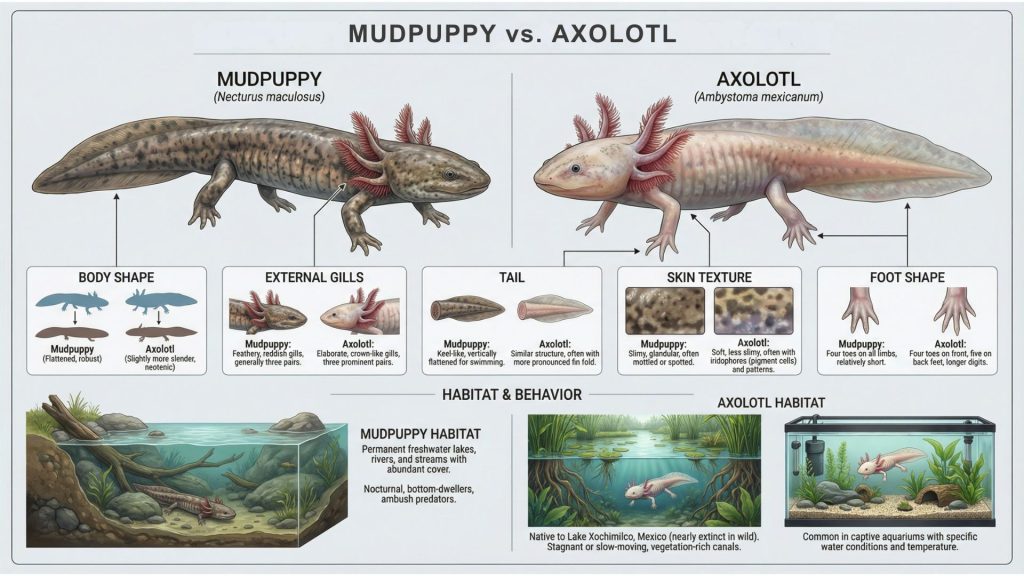
Axolotls and mudpuppies are aquatic salamanders that normally retain external gills as adults. An axolotl has five toes on each hind foot; a mudpuppy has four. They belong to different families and have different native ranges: central Mexico for axolotls and eastern North America for mudpuppies.
What is the Difference Between Axolotls and Mudpuppies?
- Axolotls are native to a very small region in Mexico. Mudpuppies occupy a wide range in the eastern United States and Canada.
- Axolotls belong to the family Ambystomatidae, while mudpuppies belong to the family Proteidae.
- Mudpuppies are generally larger and heavier than axolotls when fully grown.
- The two species have different toe counts on their hind feet, which is a key way scientists tell them apart.
- Axolotls have a much higher capacity for regenerating lost limbs and organs compared to mudpuppies.
- Both animals exhibit neoteny, which means they keep their larval features, like external gills, even as adults.
- Axolotls are critically endangered in the wild, while most mudpuppy populations are considered stable.
Physical Appearance
Size and Build
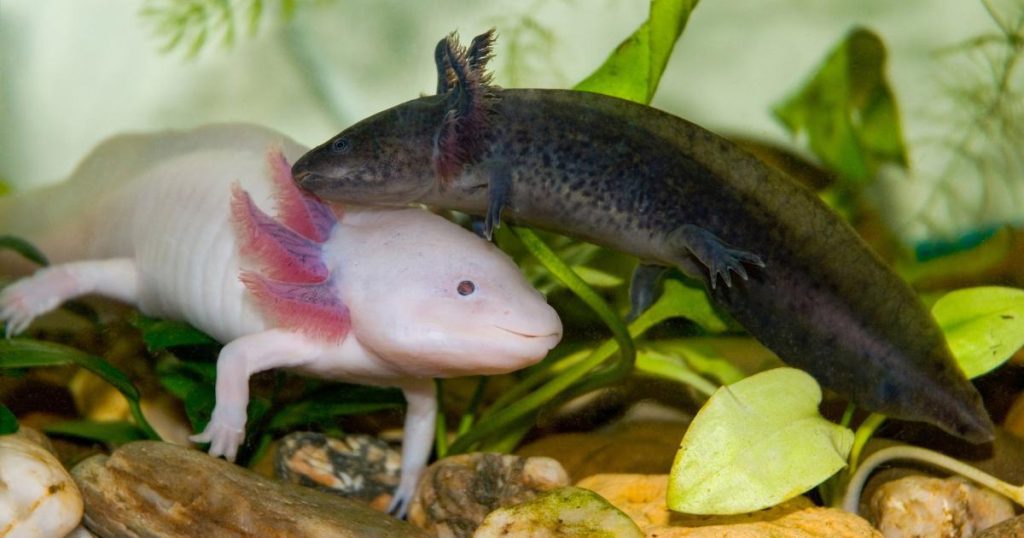
Axolotls and mudpuppies both have a slightly flattened body with a wide head, eyes spaced widely apart, four limbs, and a long, finned tail that they use for swimming. Axolotls have four toes on their front feet and five toes on their back feet. Mudpuppies have four toes on all four of their feet. Mudpuppies are generally larger and stockier than axolotls. Both axolotls and mudpuppies feature external gills sprouting from their heads.
Color and Markings
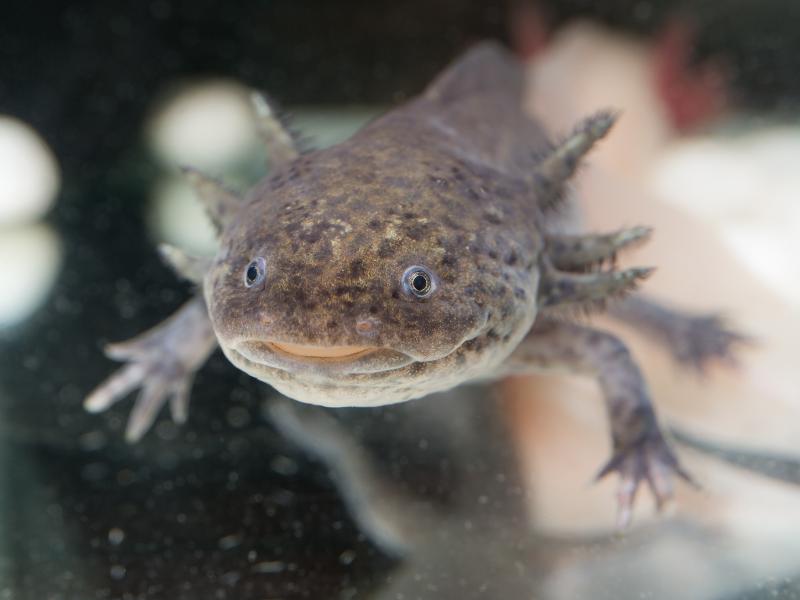
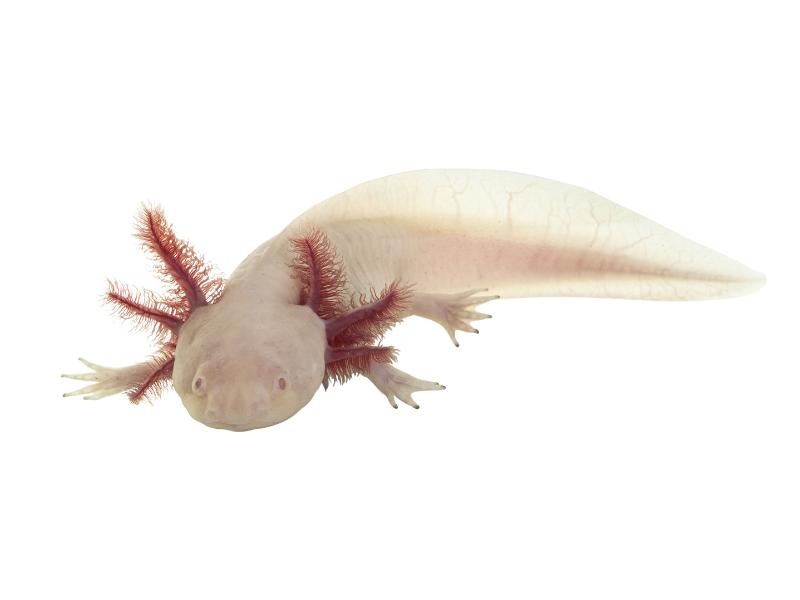
In the wild, axolotls are usually dark brown or black with olive-colored mottling. Captive axolotls are often pink or white. Mudpuppies have rusty brown or grey skin covered in distinct dark blue-black spots that help them blend into muddy river bottoms.
Habitat and Range
Geographical Range
Currently, axolotls are found naturally only in the Lake Xochimilco region near Mexico City in the southern part of North America. Mudpuppies have a much larger range, living throughout the Great Lakes, the Mississippi River basin, and various waterways in the eastern United States and Canada.
Preferred Habitat
Axolotls prefer the high-altitude, freshwater lake systems and canals of central Mexico where the water stays relatively cool. Mudpuppies live in a variety of freshwater settings, including deep lakes, murky rivers, and fast-moving streams with plenty of rocks to hide under.
Behavior and Diet
Behavior
Axolotls are generally solitary and move slowly along the bottom of their habitat, occasionally coming to the surface for a gulp of air. Mudpuppies are nocturnal hunters that stay hidden under logs or stones during the day to avoid predators.
Diet
Axolotls are carnivores that eat small prey like worms, insects, and small fish using a “vacuum” method to suck food into their mouths. Mudpuppies have a similar diet but often hunt larger fare, including crayfish, snails, and even other small amphibians.
Life Cycle, Neoteny, and Lifespan
Life Cycle
Axolotls and mudpuppies have nearly identical lifecycles: both hatch from eggs as aquatic larvae with feathery gills and never leave the water. While most other amphibians (like frogs) transform and move to land, these two species reach maturity while staying in their underwater form.
Neoteny
It is scientifically incorrect to say that an axolotl or a mudpuppy is just a “stage” of another salamander.
While they belong to families that contain land-dwelling relatives (like the Tiger Salamander), axolotls and mudpuppies are each their own distinct species. They stay in a larval state through a process called neoteny, which means they are “permanent larvae” that can still grow to full size and have babies of their own.
Do They Ever Go Through Metamorphosis?
Axolotls: In nature, axolotls almost never undergo metamorphosis. However, in rare laboratory cases or due to extreme environmental stress, they can be forced to transform into a land-dwelling salamander. This process is very hard on their bodies and often shortens their lifespan.
Mudpuppies: Unlike axolotls, mudpuppies have completely lost the biological ability to transform. No matter what happens in their environment, a mudpuppy will remain an aquatic, gill-breathing creature from the day it hatches until the day it dies.
Lifespan
In the wild, axolotls typically live for 10 to 15 years, though they can reach 20 years in carefully managed captive environments. Mudpuppies are very long-lived for amphibians, often surviving for 15 to 20 years in the wild and potentially even longer in captivity.
Cultural Significance
Axolotls hold an important place in Mexican culture. They appear in ancient Aztec mythology as the god Xolotl. Recently, they have become a modern global icon in video games and internet culture.
Mudpuppies are well-known to anglers and naturalists in the United States, often featuring in local folklore as “waterdogs” that people mistakenly believe can bark.
Conservation Status
The axolotl is currently listed as Critically Endangered due to habitat loss, pollution, and invasive species in its tiny native range. Mudpuppies are generally listed as Least Concern by international standards, though some local populations are considered Threatened due to water pollution and dam construction.