Pocket gophers are mostly solitary burrowing rodents with external cheek pouches. Prairie dogs are social members of the squirrel family that live in colonies. Compare their body shape, burrows, diets, and behavior to distinguish these North American animals.
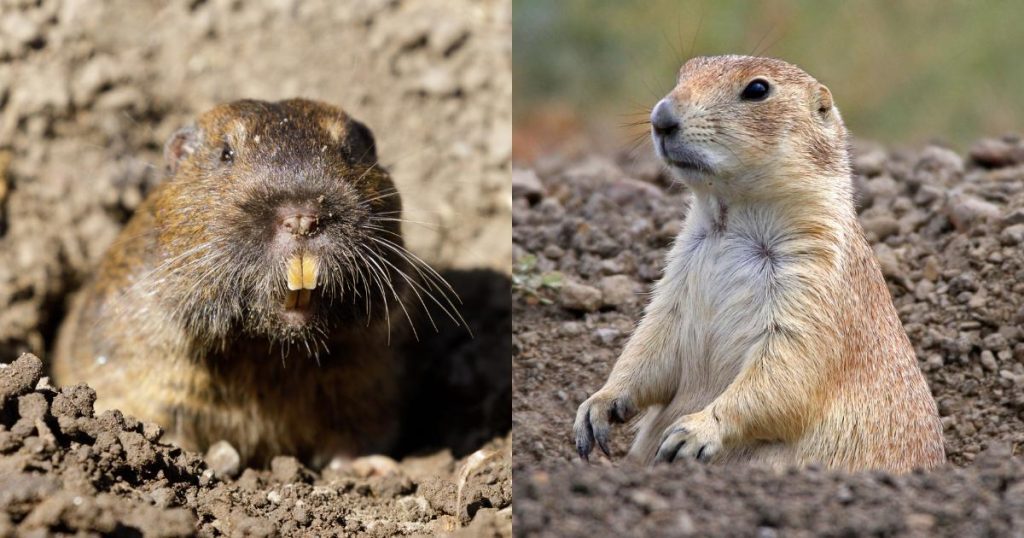
Gopher vs Prairie Dog – What is the Difference?
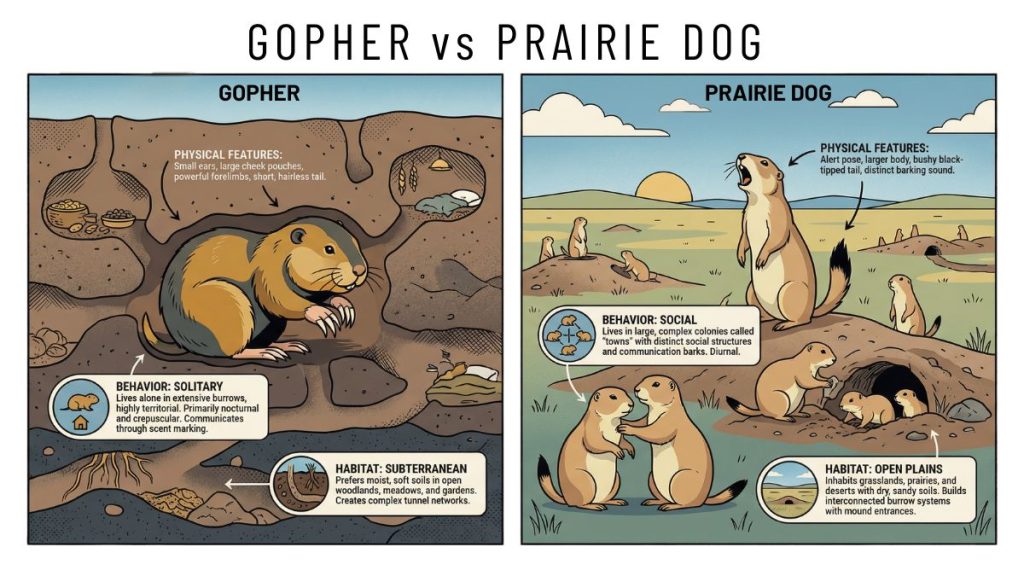
- Gophers belong to the family Geomyidae, while prairie dogs are members of the Sciuridae family.
- Prairie dogs are highly social animals that live in large colonies, whereas gophers are solitary and spend most of their lives alone.
- Gophers have fur-lined cheek pouches used for carrying food, which gives them their name.
- Prairie dogs are strictly diurnal, meaning they are active during the day, while gophers are active at various times.
- Gophers create fan-shaped mounds of dirt with a plugged entrance, while prairie dogs create volcano-like mounds with open holes.
- Prairie dogs use a complex “barking” system to communicate, a trait not found in gophers.
- Gophers have large, exposed front teeth and heavy claws specifically designed for constant digging.
Physical Appearance
Rodents
Gophers and prairie dogs are both rodents – a group of mammals characterized by a single pair of continuously growing incisors (front teeth) in both the upper and lower jaws. Both the pocket gopher and the prairie dog are classified as rodents because they must constantly gnaw on vegetation and roots to wear down these specialized teeth, which would otherwise grow too long for them to eat.
Size and Build
Gophers are generally smaller and more cylindrical, typically measuring 15 to 25 cm in length and weighing between 200 and 500 grams. Prairie dogs have a sturdier, pear-shaped build, usually reaching lengths of 30 to 40 cm and weighing between 0.5 and 1.5 kilograms.
Coat and Markings
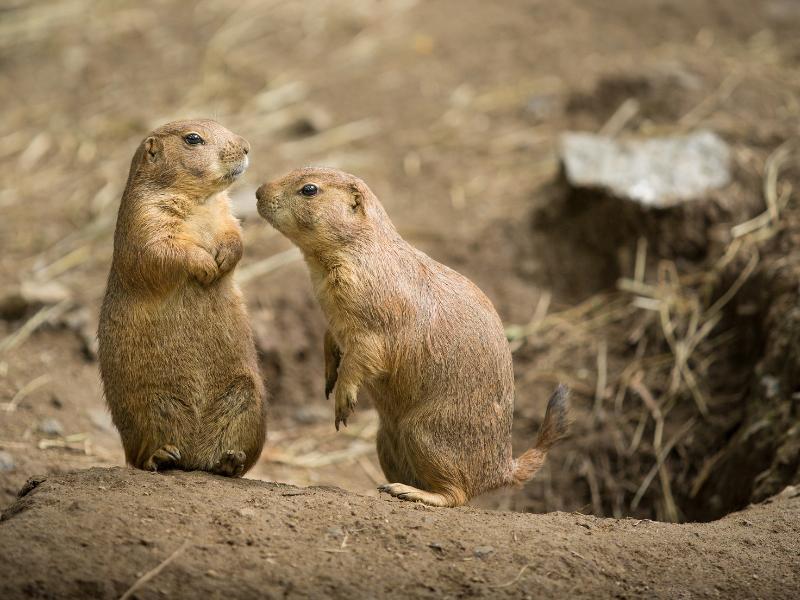
Gophers have short, soft fur that can range from brown to nearly black, often matching the color of the local soil. Prairie dogs typically have a sandy or buff-colored coat with a lighter underbelly and a tail that may have a black or white tip.
Specialized Physical Features
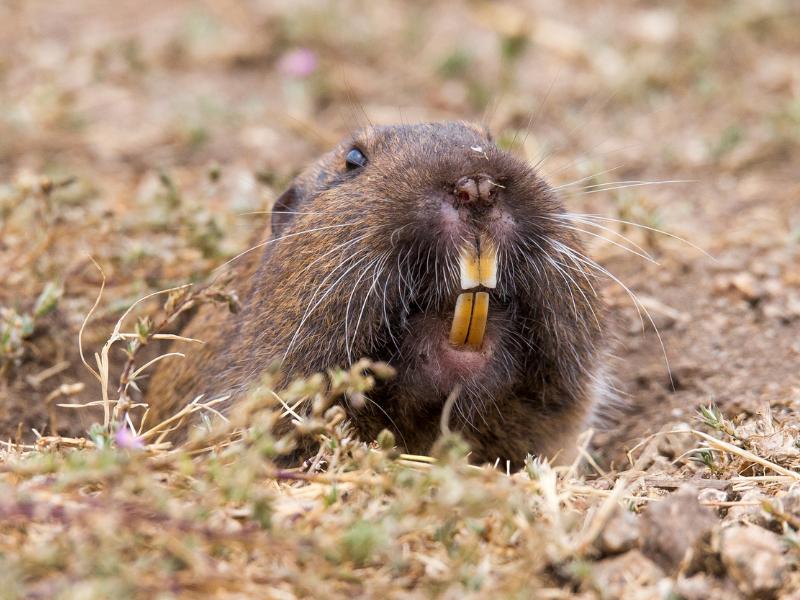
Gophers possess strong claws and large, yellowish incisor (front) teeth. These special teeth remain outside their lips so they can dig with their teeth without getting dirt in their mouths. Prairie dogs have shorter, sharp claws also well-suited for digging. Prairie dogs also have powerful hind legs that allow them to stand upright to scan the horizon for predators.
Habitat and Range
Geographical Range
Gophers are found throughout North and Central America, spanning from the mountains of Canada down to Panama. Prairie dogs have a more restricted range, living primarily in the Great Plains and high plateaus of the western United States, southwestern Canada, and northern Mexico.
Preferred Habitat
Gophers prefer areas with loose, moist soil such as meadows, forests, and even suburban gardens where they can easily tunnel. Prairie dogs thrive in short-grass or mixed-grass prairies where the vegetation is low enough for them to maintain a clear line of sight.
Behavior and Diet
Behavior
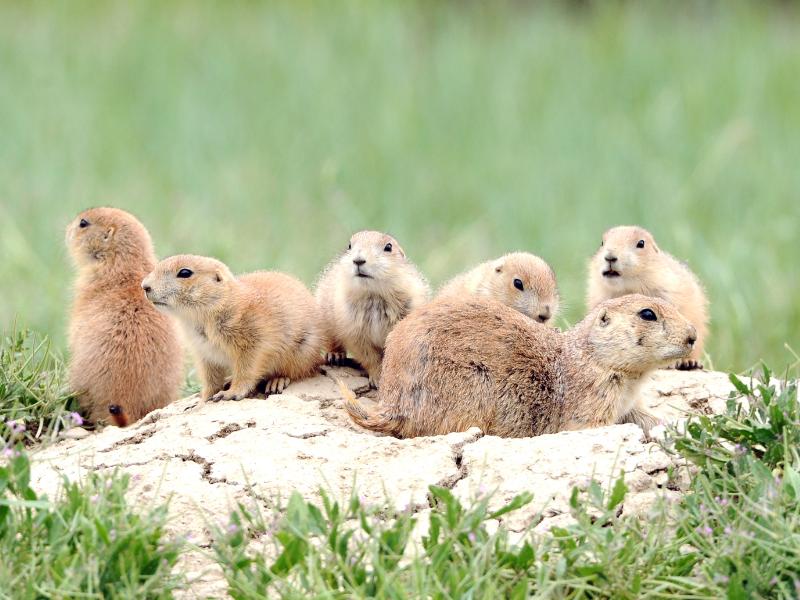
Gophers are solitary animals. They are extremely territorial and will defend their tunnel systems from any intruders, including other gophers. Prairie dogs are famously social, living in “towns” that can cover hundreds of acres and consist of thousands of individuals working together to watch for danger. Prairie dogs are famous for their extensive and varied yips and “barks.” These vocalizations are considered to be one of the most complex and sophisticated animal communication systems in the world.
Diet
Gophers are herbivores that primarily eat the roots, tubers, and bulbs of plants they encounter while tunneling underground. Gophers have special fur-lined pouches in their cheeks which they use to carry food to eat later. Prairie dogs also eat plants but focus on the surface parts, consuming grasses, seeds, and occasionally insects like grasshoppers.
Reproduction and Lifespan
Mating and Offspring
Gophers give birth once or twice a year to litters of three to six young that stay in the mother’s burrow for only a few weeks. Prairie dogs generally give birth once a year. The “pups” emerge from the burrow after about six weeks to be cared for by and incorporated into the community.
Lifespan
In the wild, gophers typically live only 1 to 3 years, though they can reach 5 years in a protected environment. Prairie dogs generally live 3 to 5 years in the wild, but they have been known to live up to 8 or 10 years when kept in captivity.
Cultural Significance
Gophers are often portrayed as pesky villains or “outlaws” because of the damage they can do to crops and lawns. Prairie dogs are frequently seen as icons of the American West, celebrated for their complex social structures and their famous “jump-yip” displays.
Conservation Status
Most species of gophers are currently classified as Least Concern. Most prairie dog species are also listed as Least Concern. One exception is the Utah Prairie Dog, currently listed as Threatened due to habitat loss and historical eradication programs.
The “Imposter” Gophers
Sometimes, other animals are called gophers by mistake. While many people use the word “gopher” to describe any small hole-digging animal, scientists use the term more specifically. In the world of biology, a “true” gopher is always a pocket gopher, named for the fur-lined pouches in its cheeks used to carry food and nesting materials.
Here are the most common “imposters”:
- Richardson’s Ground Squirrel: Often called “gophers” in the northern prairies, these are actually social squirrels.
- Thirteen-Lined Ground Squirrel: The inspiration for the “Golden Gopher” mascot, but biologically a squirrel.
- Voles and Moles: Homeowners often blame “gophers” for lawn tunnels that are actually made by these smaller insect-eaters or rodents.
- Gopher Tortoise: A reptile found in the southeastern United States that shares the name because it also digs deep burrows.