Frogs are among the most unique creatures in the animal kingdom, known for their incredible transformation as they grow from tiny eggs into fully developed adult frogs. The life cycle of a frog shows how living creatures can grow and change dramatically. Frogs go through four main stages: egg, tadpole, froglet, and adult frog. This process, known as metamorphosis, is key to their survival and helps them adapt to different environments.

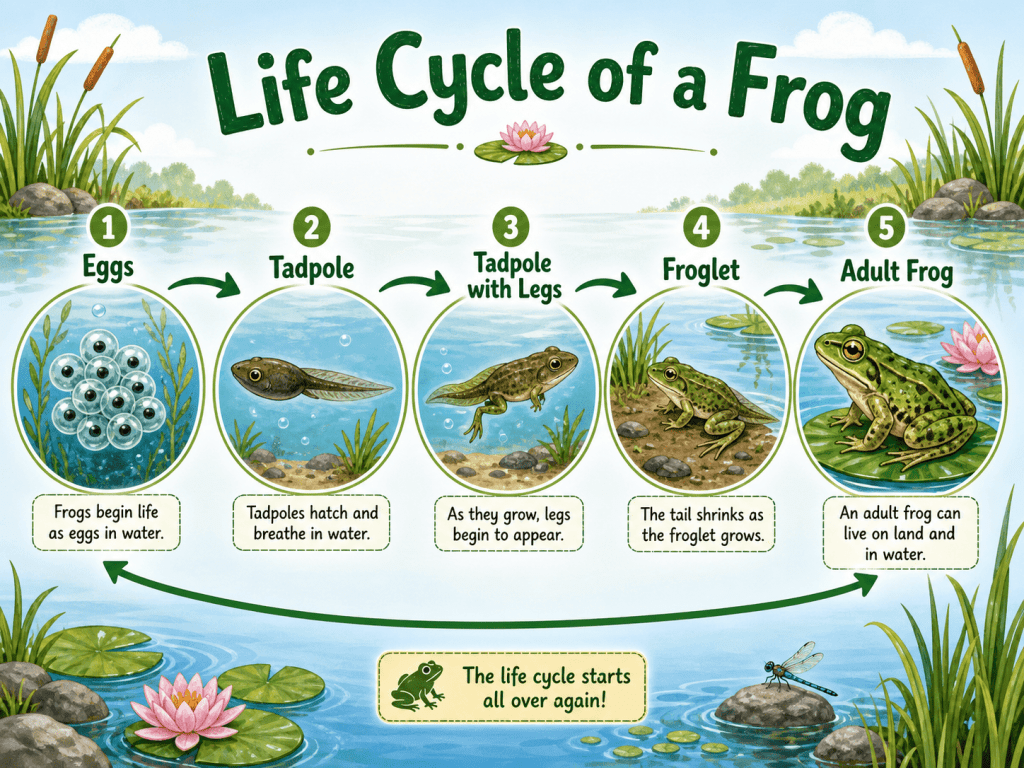
The Four Stages of a Frog’s Life Cycle:
1. Egg Stage

The egg stage is the very beginning of a frog’s life cycle. Female frogs lay their eggs in water, often in large clusters called “frogspawn.” These eggs are surrounded by a jelly-like coating that helps protect them from predators and keeps them moist. Depending on the species, a single frog can lay hundreds or even thousands of eggs at a time.
Frogs lay thousands of eggs at a time because many do not survive. Predators, disease, and environmental factors can cause high egg mortality.
Inside each egg, a tiny tadpole begins to develop, and after a few days or weeks, the eggs hatch. The warm, wet environment of the water is crucial during this stage, as it allows the embryos to grow and prepares them for the next phase of their life cycle.
2. Tadpole Stage

When the eggs hatch, tiny tadpoles emerge. The tadpole stage is when the newly hatched frog begins to take shape, but it looks more like a fish than a frog at this point. Tadpoles are fully aquatic, living in water and using gills to breathe. They have long, slender tails that help them swim and tiny mouths that allow them to feed on algae and plant matter. As tadpoles grow, they start to develop hind legs, and their gills begin to be replaced by lungs, preparing them for life on land.
If a tadpole doesn’t grow legs, it may not survive because it needs legs to leave the water and become a frog. This could happen due to environmental issues or developmental problems.
This stage lasts several weeks, during which the tadpole grows rapidly, storing energy for the upcoming transformation into a froglet. It’s an essential phase in the frog’s life cycle, as it prepares the tadpole for its eventual shift to a land-dwelling creature.
3. Froglet Stage

The froglet stage is a transitional phase in a frog’s life cycle when the tadpole begins to resemble a young frog. As tadpoles grow into froglets, they begin to develop legs, and their tails start to shrink. They also develop lungs to breathe air. During this stage, the tadpole looks more like a frog but still has a small tail. While it can now hop and move around on land, the froglet may still stay near water as it continues to grow.
During the froglet stage, the tadpole’s tail begins to shrink and is gradually absorbed into the body as the froglet develops into an adult frog. This process happens because the frog is transitioning from living primarily in water to being able to survive on land. The tail, which was important for swimming as a tadpole, is no longer needed once the froglet grows legs and starts hopping around. By the end of the froglet stage, the tail is completely gone, and the frog is ready to live as an adult frog.
This stage is a critical period of adaptation, as the froglet moves from being a fully aquatic tadpole to a semi-aquatic adult frog capable of living both on land and in water.
4. Adult Frog Stage

The adult stage marks the final phase of a frog’s life cycle, where the frog is fully developed and capable of living both on land and in water. At this point, the froglet’s tail disappears completely, and it becomes an adult frog. The frog has fully formed legs for jumping and a strong muscular body adapted for a life of hunting insects, small invertebrates, and sometimes even small vertebrates. The lungs are fully functional, allowing the frog to breathe air, but it can also absorb oxygen through its skin when submerged in water. Adult frogs return to water to breed, starting the life cycle all over again.
The frog life cycle takes about 12 to 16 weeks, but this can vary depending on the species and environmental conditions.
Adult frogs need water to keep their skin moist and to lay their eggs. Without access to water, frogs will dehydrate and die.
Frogs use camouflage, poisonous skin secretions, and quick jumps to escape predators. Some frogs also play dead to avoid being eaten.
Depending on the species, frogs may live for several years in the wild, contributing to their ecosystems by controlling insect populations and serving as prey for larger animals. The adult stage is the most mobile and independent part of a frog’s life, allowing them to explore a range of habitats.
More Information About Frogs
Metamorphosis
This is the process of changing from one form to another. For frogs, this process happens as they grow from a tadpole into an adult frog.
Lifespan
Frogs typically live for 6 to 10 years, depending on the species.
Habitat
Frogs need moist environments to survive, so they are often found near ponds, lakes, and other bodies of water.
Diet
Tadpoles are herbivores, feeding on plants, while adult frogs are carnivores, feeding on insects, spiders, and small invertebrates.

Fun Facts About Frogs
Frogs are amphibians, a type of vertebrate that can live both in water and on land. Amphibians are cold-blooded animals that typically start their life in water as larvae (such as tadpoles) and undergo metamorphosis to develop into their adult form.
Frogs can breathe through their skin. In addition to using lungs, frogs absorb oxygen directly through their skin when they’re in water. This helps them stay underwater for long periods.
Frogs can leap up to 20 times their body length! Many frogs are excellent jumpers. A single leap can take them as far as 20 times their own size, which helps them escape predators quickly.
Frogs don’t drink water. Frogs absorb water through their skin instead of drinking it. They have a special area on their belly, called a “drinking patch,” that helps them soak up water from their surroundings.
Some frogs can change color. Certain species of frogs can change their skin color to blend in with their environment, much like chameleons.

Frogs were around before dinosaurs. Fossil evidence shows that frogs have been on Earth for at least 200 million years, which means they were hopping around long before dinosaurs!
The world’s smallest frog is the size of a pea! The Paedophryne amauensis, a tiny frog found in Papua New Guinea, measures only about 7.7 mm, making it the smallest vertebrate on Earth.

Frogs can freeze – and survive. Some frogs, like the wood frog, can actually survive being frozen during the winter. Their bodies produce a kind of natural antifreeze to protect their cells.
The golden poison dart frog is deadly. Native to Colombia, the golden poison dart frog is one of the most poisonous animals on the planet. Just one frog has enough toxin to kill 10 adult humans.

Frogs use their eyes to help them swallow. When a frog eats, it blinks to help push the food down its throat. Their eyes actually sink into their head and press against the roof of their mouth!
There are over 7,000 species of frogs. Frogs are found on every continent except Antarctica. They come in all sizes, shapes, and colors!
