Egrets are members of the heron family, so white heron and white egret are overlapping common names. Here, Great White Heron means the white form of the Great Blue Heron, and Great Egret means Ardea alba. Pale versus black legs and overall size help distinguish them.

A Note about the Phrases “White Heron” and “White Egret”
Egrets are part of the heron family, Ardeidae. White heron is a descriptive common name that can refer to several birds. This article compares the Great White Heron, a white form of the Great Blue Heron, with the Great Egret.
The White Heron (Ardea herodias occidentalis) is a large, all-white relative of the Great Blue Heron.
Egrets come in a range of sizes, many with mostly or completely white feathers. However, only one particular species of egret is large enough to be confused with the White Heron: the Great Egret (Ardea alba). In this post, we will use the term “White Egret” to refer to the Great Egret.
White Heron vs White Egret: What is the Difference?
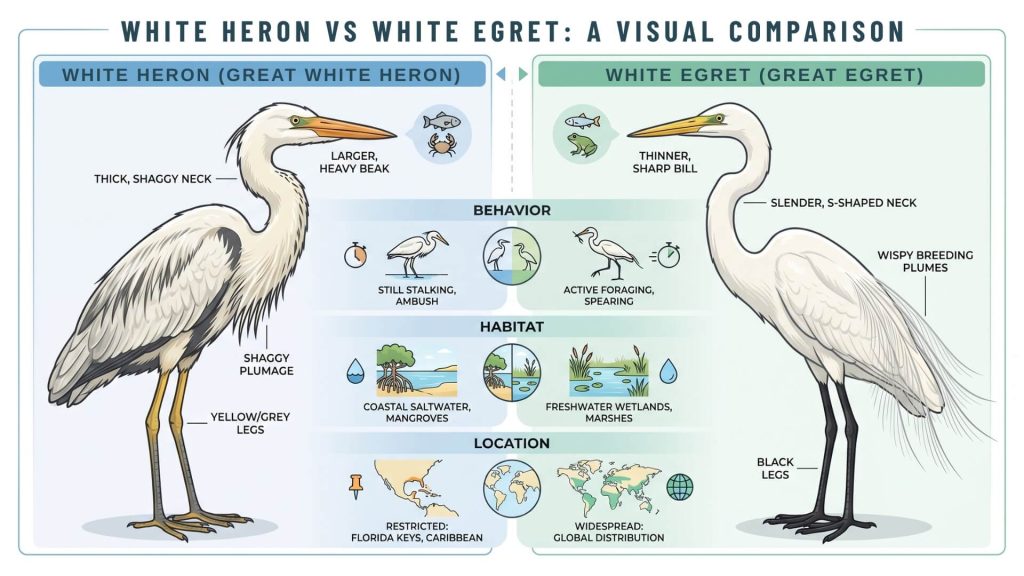
- The White Heron is taller and heavier than the White Egret.
- White Herons are adapted to thrive in saltwater environments. White Egrets are generalists and can live in a variety of habitats including freshwater and saltwater.
- White Herons have a thick, heavy bill. White Egrets have a thinner, lighter bill.
- White Herons have pale, yellowish or greenish legs and feet. White Egrets have black legs and feet.
- White Herons are quite limited in their geographic range: they live in the Caribbean islands and the southernmost coastal areas of Florida, including the Florida Keys. White Egrets are one of the most common large waterbirds, found on every continent across the globe except Antarctica.
Physical Appearance
Size and Build
The White Heron stands about 50 inches tall and weighs around 5 to 6 pounds. The White Egret is smaller, reaching 39 inches in height and weighing only 2 pounds. The heron has a visibly thicker neck and a heavier frame.
Feathers and Markings
White Herons have solid white feathers with no dark markings at any age. White Egrets also have pure white plumage that is sometimes described as “glowing” in the sunlight. Both White Heron and White Egret chicks have soft, fluffy white feathers.
During the breeding season, the White Egret grows long, lacy feathers on its back called aigrettes. These delicate plumes were once highly valued for decorating hats.
Head, Bill, and Neck
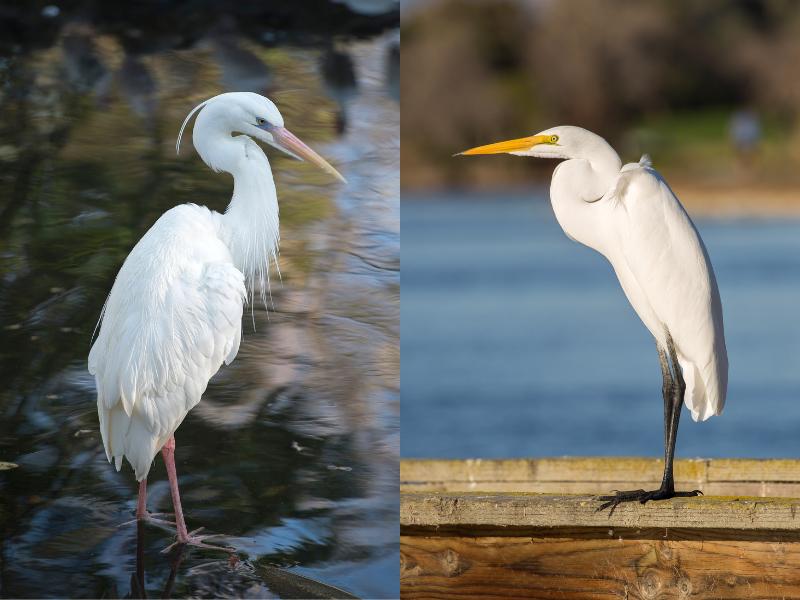
The White Heron often displays short, white plumes extending from the back of its large head, while the Great White Egret lacks a prominent head crest and has a smooth, rounded head shape.
White Herons have a long, somewhat thick neck with a massive, heavy bill that is dull yellow. White Egrets have a long, thin neck with a much slimmer yellow bill.
While standing or hunting, the White Heron often holds its thick neck in a more upright or loosely curved position, whereas the White Egret typically pulls its thinner neck into a tight, sharp “S” shape. When in flight, both birds tuck their heads back toward their shoulders, but the heron’s massive neck appears much bulkier compared to the slender, streamlined profile of the flying egret.
Legs and Feet
Color as an Identifier
Great White Herons usually have pale legs, while American Great Egrets have black legs and feet. Snowy Egrets are smaller and have black legs with yellow feet.
Foot Structure
Both the White Heron and the White Egret have non-webbed feet with four long, slender toes. Three toes point forward and one points backward, creating a wide “footprint” that acts like a snowshoe. This specialized shape prevents them from sinking into deep, soft mud or sand as they stalk their prey.
The “Comb” Claw
One of the most fascinating features of their feet is a specialized claw on the middle toe called a pectinate claw. This claw has tiny, comb-like ridges. Both birds use this “built-in comb” to groom their feathers, remove parasites, and clean off the slimy fish oils and powder down that accumulate after a day of hunting.
Habitat and Range
Preferred Habitat
While both are wetland birds, they are found in different types of wetland habitats. White Herons are mainly restricted to saltwater environments such as shallow marine bays, tidal flats, and mangrove islands. They rarely venture into freshwater areas, making them true coastal specialists. White Egrets, however, are found in a huge variety of habitats, including freshwater, brackish, and saltwater. You are just as likely to see a White Egret in a suburban drainage ditch as you are in a coastal salt marsh.
Geographical Range
The White Heron has a very small range, living almost entirely in the Florida Keys, South Florida, and parts of the Caribbean. Because they are so tied to the salty coastal waters of these tropical regions, they do not wander far inland. The White Egret lives across most of the world and moves freely between coastal and inland freshwater habitats on nearly every continent.

Behavior and Diet
Behavior
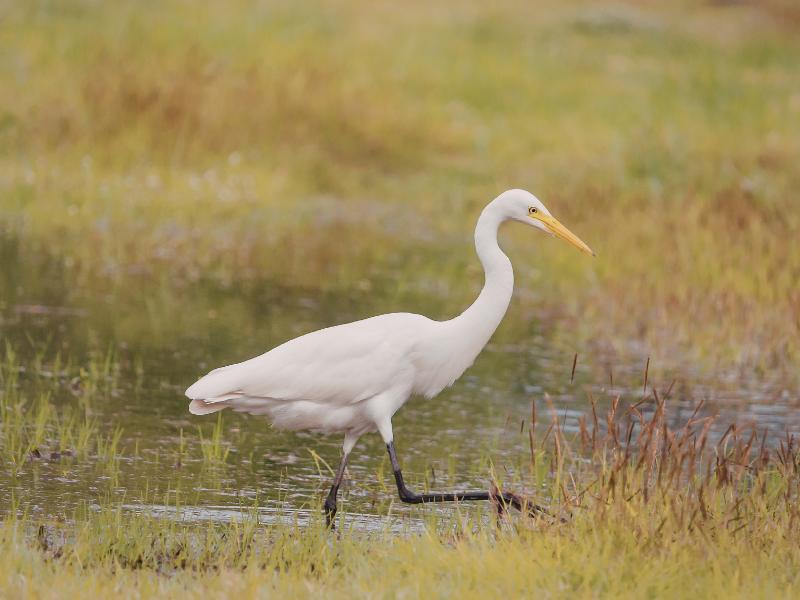
The White Heron is a master of patience, often standing motionless for long periods in shallow saltwater while waiting for heavy prey to swim within reach. It is a highly territorial hunter that will aggressively defend its feeding spot from other birds. In contrast, the White Egret is much more active and mobile while searching for food. It frequently wades through the water with steady steps or uses a clever “foot-stirring” motion to vibrate the mud and flush out hiding fish.
Diet
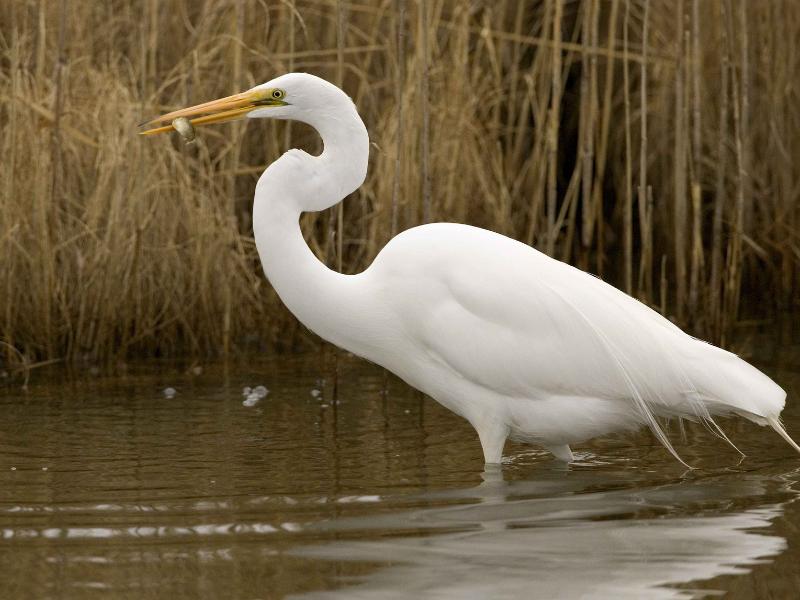
White Herons focus on high-calorie meals and are capable of swallowing surprisingly large fish, heavy crabs, and occasionally even small ibises or other water birds. Their massive bills allow them to handle much tougher and larger prey than most other wading birds. White Egrets have a more varied but smaller-scale diet consisting of small fish, frogs, aquatic insects, and snakes. On land, they are also known to hunt for grasshoppers and lizards in open fields.
Hunting and Feeding Styles
Both birds are primarily diurnal, meaning they are most active during the daylight hours. The White Heron relies almost entirely on “stand and wait” stealth to ambush its meals. The White Egret uses a wider variety of techniques, including “low and slow” stalking and occasionally hovering over the water to snatch prey from the surface.
Both species use their sharp, dagger-like bills to strike with lightning speed once a target is identified. The White Heron typically uses its bill strength to grab and crush its prey before swallowing it whole. The White Egret often uses a precision “spearing” motion to pin smaller, faster prey before tossing them back into its throat.
Reproduction and Lifespan
Nesting and Offspring
White Herons build their nests out of large sticks in coastal trees. White Egrets nest in groups called colonies, often mixing with other types of water birds. Both types of birds provide careful care for their chicks until they can fly.
Lifespan
In the wild, these large birds usually live for about 15 years. In captivity, they can live as long as 20 years and even beyond. While heron and egret chicks are vulnerable in their first year due to predators, their main threats as adults are habitat loss and extreme weather.
Cultural Significance
The White Egret is the official symbol of the National Audubon Society. People once hunted these birds nearly to extinction for their beautiful feathers. Today, they are protected by law and are often prized by photographers all over the world.
Conservation Status
Great White Herons are a geographically restricted white form of the Great Blue Heron, not a separate globally assessed species in the usual treatment. Their local conservation needs should be distinguished from the status of the Great Egret. Both depend on protected wetland habitat.