Pine vs Cedar: many people use these two terms interchangeably to describe any tree with cones and thin, pointed leaves. While pines and cedars share many features, they are scientifically distinct from one another and have distinct physical traits. Learning their differences makes identification much easier.
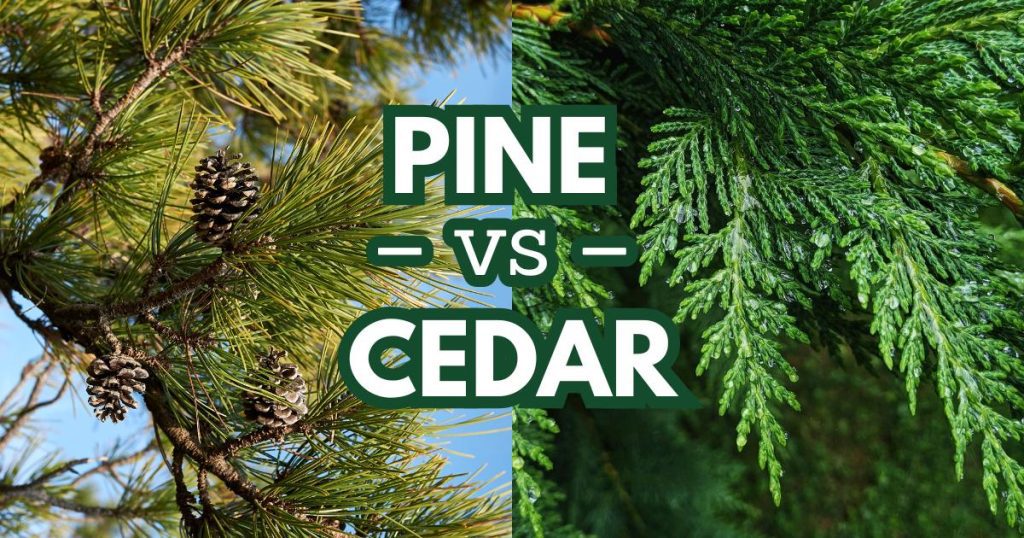
True Cedars versus False Cedars
Before continuing, it’s important to note that botanists distinguish between “true” and “false” cedars.
True cedars belong to the genus Cedrus. They are native to the Mediterranean and the Himalayas.
Most cedars in North America are actually false cedars, in the genus Cupressaceae. They belong to the cypress family. This group includes the Eastern Red Cedar and Western Red Cedar. These trees are more closely related to junipers.
The name confusion began with with arrival of European settlers in North America. These settlers encountered evergreen trees with various types of cones and fragrant, rot-resistant wood, and described them as “cedars” since the trees were similar to cedar trees they had seen before (something similar happened with “buzzards” and “vultures”). Scientifically, the North American trees were different. However, the common names became permanent. Today, we still use these names in forestry and construction.
In this article, we will use the terms “true cedar” and “false cedar” for clarity when comparing cedar trees with pine trees.
Pine vs Cedar: Physical Appearance
Pines and cedars are both evergreen conifers.
Evergreen refers to a plant’s ability to retain its green foliage through all seasons rather than shedding its leaves annually.
Conifer refers to a group of trees that reproduce using cones and typically possess needle-like or scale-like leaves.
Pines and cedars may look similar from a distance but have unique physical traits.
Height and Growing Habit
A plant’s “habit” is the shape it takes as it grows.
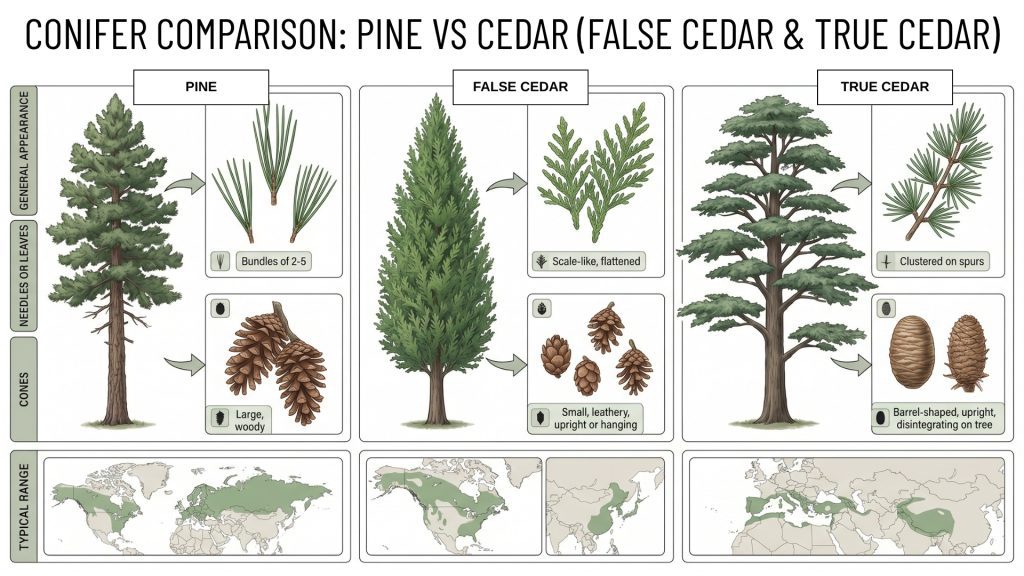
Most pine trees have a tall, upright habit, though many pine species are more cone-shaped. Pine trees often reach heights between 15 and 45 meters.
False cedars tend to have a pyramidal or columnar habit. Their height ranges from 10 to 60 meters depending on the species.
True cedars generally have a massive, spreading habit with distinct horizontal branching. Their height ranges from 20 to 40 meters.
Bark Style
Pine bark is typically thick, rough, and deeply furrowed, often breaking into large, scaly plates.
False cedar bark is thin and fibrous, frequently peeling off the trunk in long, vertical, stringy strips.
True cedar bark begins as smooth and grey on young trees, eventually developing shallow fissures and small scales as the tree matures.
Leaf Shape
Both pines and true cedars have needle-shaped leaves, though the length and arrangement of the needles differ. False cedars have a different leaf shape altogether.
Pine needles are long and narrow. These needles can grow from 3 to 45 centimeters. Pine needles grow in bundles called fascicles. Each bundle usually contains two to five needles.
True cedar needles are short and rigid. These needles typically grow from 1 to 5 centimeters long. True cedar needles are arranged in dense, spiral, star-like clusters on the twigs.
False cedar leaves are actually tiny, overlapping scales that are usually less than 1 centimeter long. These scales are arranged in flat, fan-like sprays along the twigs.
Cone Shape and Characteristics
Pine cones have thick, woody scales that protect the developing seeds. Pine cones can range from 3 to 30 centimeters in length. These cones typically hang downward from the branches. The entire pine cone falls from the tree when the seeds are mature.
False cedar cones are much smaller. Many stay under 2 centimeters in length. Some even look like tiny, blue berries.
True cedar cones are barrel-shaped and sit upright on top of branches. The scales of cedar cones fall off while still on the twig.
Pine vs Cedar: Habitat, Range, and Lifespan
Preferred Habitat/Growing Conditions
Pines thrive in acidic soil and plenty of direct sunlight. They often grow well in sandy or rocky areas.
False cedars generally prefer moist, nutrient-rich soils and are frequently found in swamps or damp forests. While they enjoy moisture, they also require well-draining conditions to prevent root rot.
True cedars prefer well-drained soil in mountainous regions. Cedar trees can tolerate cooler climates and higher elevations.
Geographical Range
Pines are found across the Northern Hemisphere from the Arctic to the tropics. They are the most common conifers in many North American forests.
False cedars are widely distributed across North America and East Asia. They are especially prevalent in the damp climates of the Pacific Northwest and the southeastern United States.
True cedars are native to the Mediterranean region and the western Himalayas. They are rarely found growing naturally outside of these specific areas.
Lifespan
In general, pines and cedars are hardy plants with long lifespans. Wild pine trees can live for 100 to 1,000 years. Cultivated pines in gardens usually live for 50 to 100 years.
Depending on the specific environment, wild false cedars can live anywhere from 150 to over 800 years. In the wild, true cedars can live for over 1,000 years in the mountains. Ornamental true cedars often reach 150 years in city parks.
Interaction with Other Species
Pines and cedars are all important species in their respective ecosystems. For example:
- The Whitebark pine has a special relationship with Clark’s Nutcrackers. These birds collect and bury the pine seeds for food. This process helps the trees spread to new areas.
- The Eastern red cedar (a false cedar) provides food for the Cedar Waxwing bird. The birds eat the small, blue, berry-like cones. They later spread the seeds through their droppings.
- The Atlas cedar (a true cedar) hosts specialized insects like aphids. These insects are a vital food source for local birds. Large birds often build nests in the tree’s wide, flat canopy.
Economic Importance
Pine wood is a major source of timber for construction and paper production. Resins from pines help create turpentine and strong industrial adhesives.
False cedars provide durable wood for outdoor fences and roofing shingles. This wood naturally resists decay and insects without needing chemical treatments.
True cedar wood is highly valued for its natural scent and durability. It is a traditional choice for making fine furniture, chests, and ships.
Conservation Status
Most pine species are classified as Least Concern by conservation groups. However, certain types like the Torrey Pine are considered Endangered.
Many false cedar species are listed as Least Concern because they are abundant and widely distributed. Some false cedars, such as the Western Red Cedar (Thuja plicata), have seen significant declines in old-growth populations due to logging, though they are not currently listed as Endangered.
True cedars are generally listed as Least Concern globally. One exception is the Atlas Cedar, currently classified as Endangered in its native range due to habitat loss.